Microcontroller education becomes truly effective when theory meets hands-on practice. Many years ago, I designed and built a Universal PIC Microcontroller Trainer Kit – Complete Embedded Systems Lab Platform with one clear goal:
👉 to allow students and engineers to experiment, test, debug, and learn embedded systems on a single integrated platform.
This article documents the design philosophy, hardware features, and educational value of this trainer kit, which is still highly relevant for today’s electronics laboratories.
Disclaimer: Electricity is always dangerous. Proper skill is required to work with electricity. Do work at your own risk. The author will not be responsible for any misuse or harmful act. Most of the projects published here are open source; anything copying and directly posting on your website and then claiming it as yours is a prohibited and nonsensical act. A project can be open-sourced, but making a working product needs lots of effort. As products make money from a business, products are not free, but knowledge will always be free. If you want to grow your business using our products, you should pay for that. Thanks.
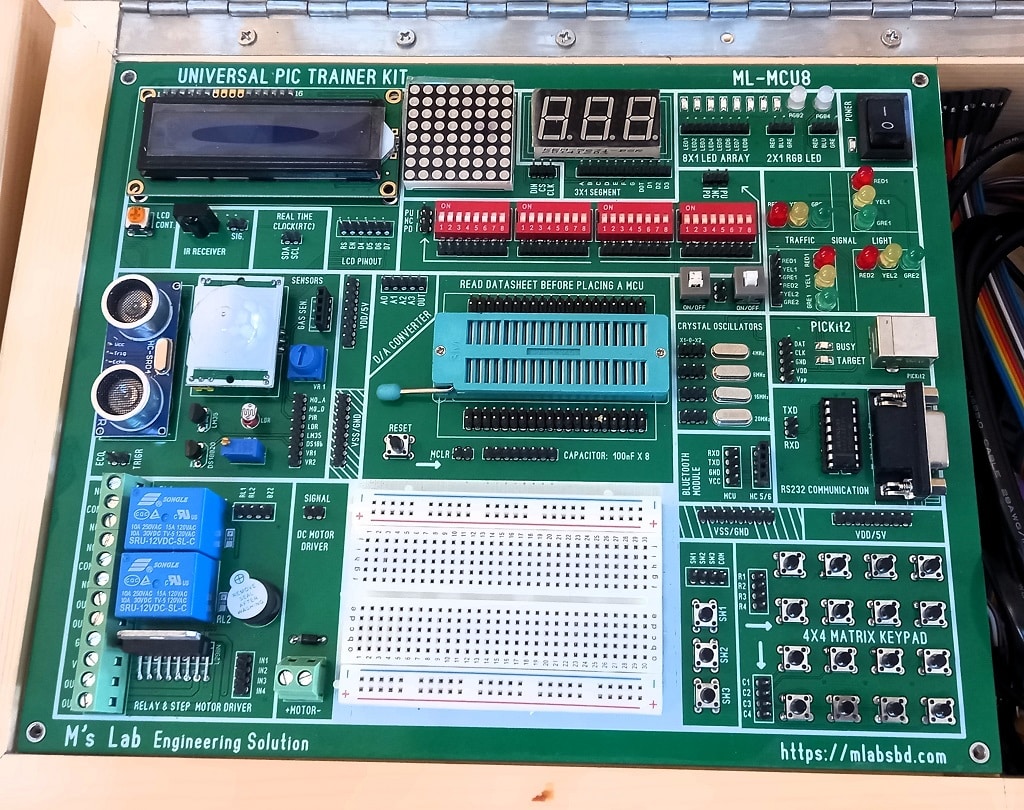
Table of Contents
🔧 Why I Designed This PIC Trainer Kit
Most beginner kits suffer from at least one of these problems:
- Limited peripherals
- Fixed MCU only
- External modules required
- Poor visibility of signals
This trainer was designed as a lab-grade learning platform, not a toy board.
Design goals:
- Support multiple PIC MCUs
- Provide real-world peripherals
- Allow signal probing & experimentation
- Suitable for students, teachers, and R&D labs
🧠 Supported Microcontrollers
The trainer supports DIP-package PIC microcontrollers, including:
- PIC16F series
- PIC18F series
Using a ZIF socket, MCUs can be swapped easily without soldering—perfect for classroom environments.
🧩 Onboard Hardware Features
📟 Display Interfaces
- 16×2 LCD module
- 8×8 LED dot matrix
- 3-digit 7-segment display
- RGB LEDs
- Individual status LEDs
These displays allow students to practice:
- Port manipulation
- Multiplexing
- Timer-based refresh
- PWM control
🎛 Input & Control Devices
- 4×4 Matrix Keypad
- Multiple tactile push buttons
- DIP switches for logic testing
Ideal for learning:
- Key scanning algorithms
- Interrupt handling
- Debouncing techniques
🔌 Communication Interfaces
- RS232 (UART)
- USB PICkit2 programming interface
- Bluetooth header (HC-05 / HC-06 compatible)
Students can test:
- Serial protocols
- PC-to-MCU communication
- Wireless control basics
🌡 Sensors & Analog Section
- Ultrasonic sensor
- PIR motion sensor
- LDR, potentiometer
- Dedicated ADC test points
This section is perfect for:
- ADC experiments
- Sensor calibration
- Real-world signal conditioning
⚡ Power & Clock System
- Multiple crystal oscillator options
- Onboard regulated power supply
- Decoupling capacitor bank
- Reset & MCLR circuitry
Students clearly understand:
- Clock source selection
- Startup behavior
- Noise & stability issues
🔁 Actuator Control
- Relay outputs
- DC motor driver
- Stepper motor interface
These allow:
- Industrial-style control experiments
- Load switching demonstrations
- Automation project simulations
🧪 Prototyping Area
A large solderless breadboard area is included so users can:
- Add custom circuits
- Test sensors or ICs
- Extend experiments beyond onboard hardware
🏫 Ideal Use Cases
This trainer kit is suitable for:
✅ Polytechnic & university labs
✅ Embedded systems courses
✅ Microcontroller workshops
✅ Final-year student projects
✅ Self-learning engineers
🎓 Educational Value
With this single board, students can learn:
- Digital I/O
- Timers & interrupts
- ADC & PWM
- Communication protocols
- Embedded system debugging
Most importantly, they learn how real embedded hardware behaves, not just simulations.
Read:
- PWM and CCP module: Learning PIC microcontrollers [Chapter 11]
- Learning ADC of PIC microcontrollers: Learning PIC microcontrollers [Chapter 8]
🔮 Why This Design Is Still Relevant Today
Even in the era of STM32 and ESP32, PIC microcontrollers remain widely used in:
- Industrial controllers
- Power electronics
- Low-cost embedded products
This trainer builds strong fundamentals, which directly transfer to advanced MCUs.
Find this:
📸 Final Thoughts
This Universal PIC Trainer Kit represents practical engineering, built from real teaching experience—not copied reference designs.
If you’re planning to design your own trainer kit or modernize lab equipment, this architecture is a proven foundation.
Liked this article? Subscribe to our newsletter:
or,
Visit LabProjectsBD.com for more inspiring projects and tutorials.
Thank you!



0 Comments