An advanced microcontroller trainer kit is essential for learning embedded systems, IoT, and real-world electronics design. Many existing kits focus only on one platform, but modern engineering education requires multi-controller, sensor-rich, and communication-ready hardware.
This article presents a fully integrated Advanced Microcontroller & IoT Trainer Kit, designed for engineering labs, universities, training centers, and self-learning engineers.
Disclaimer: Electricity is always dangerous. Proper skill is required to work with electricity. Do work at your own risk. The author will not be responsible for any misuse or harmful act. Most of the projects published here are open source; anything copying and directly posting on your website and then claiming it as yours is a prohibited and nonsensical act. A project can be open-sourced, but making a working product needs lots of effort. As products make money from a business, products are not free, but knowledge will always be free. If you want to grow your business using our products, you should pay for that. Thanks.
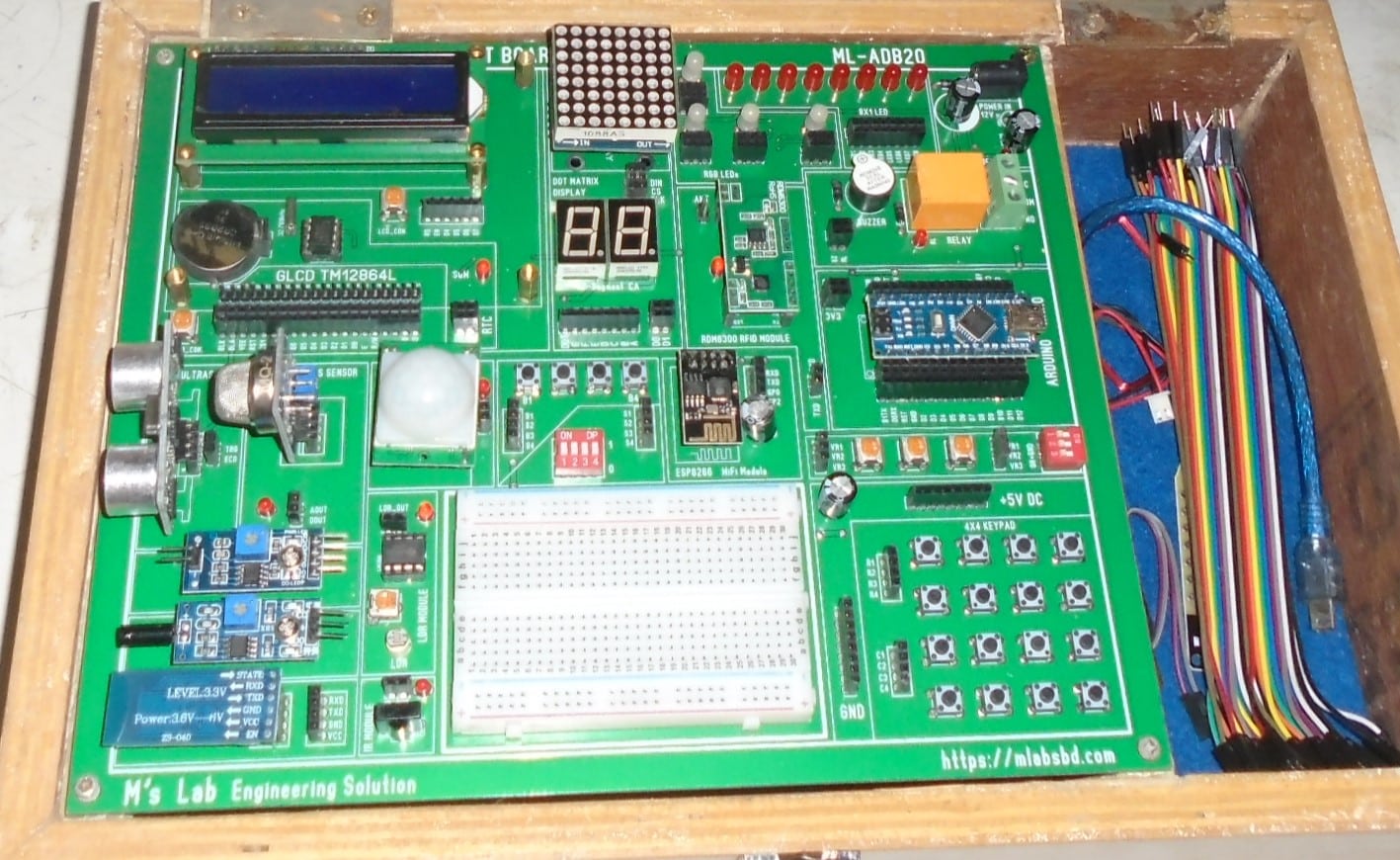
Table of Contents
Why This Trainer Kit Was Designed
Most training boards fail to cover:
- IoT communication
- Multiple controller platforms
- Real sensor interfacing
- Industrial-style input/output
This trainer kit was designed to:
- Support Arduino, ESP8266, and external MCUs
- Provide hands-on IoT experiments
- Eliminate the need for external modules
- Serve as a complete embedded systems laboratory
Supported Controller Platforms
This trainer kit supports multiple development approaches:
Arduino Platform
- Dedicated Arduino Nano socket
- Direct access to GPIO, UART, SPI, and I2C
- Ideal for beginners and rapid prototyping
ESP8266 WiFi Platform
- Onboard ESP8266 WiFi module
- Enables IoT experiments
- Supports cloud connectivity and wireless control
External Microcontroller Support
- Header-based interface for:
- PIC microcontrollers
- AVR
- STM32
- Allows students to migrate from Arduino to professional MCUs
Display and Visual Output Modules
The board includes multiple display interfaces:
- 16×2 Character LCD
- GLCD (Graphic LCD) support
- 8×8 LED dot matrix
- Dual 7-segment display
- RGB LEDs
- Individual indicator LEDs
These displays help students learn:
- Port control
- Display protocols
- Timing and multiplexing
- Graphics rendering basics
Input Devices and Human Interface
Matrix Keypad
- 4×4 keypad
- Ideal for menu systems and password projects
Push Buttons
- Multiple tactile switches
- Used for interrupts, polling, and user input
DIP Switches
- Logic testing
- Configuration selection
- Digital input experiments
Sensor Integration Section
This trainer kit includes multiple real-world sensors:
- Ultrasonic distance sensor
- PIR motion sensor
- LDR light sensor
- Temperature and analog sensor modules
- Adjustable potentiometers
These sensors allow experiments on:
- ADC conversion
- Sensor calibration
- Environmental monitoring
- Signal conditioning
Communication and IoT Interfaces
The board supports multiple communication methods:
- UART (Serial Communication)
- ESP8266 WiFi
- RFID module interface
- USB-to-Serial connectivity
Students can build:
- IoT monitoring systems
- RFID access control projects
- Wireless sensor networks
- Cloud-connected devices
Output and Control Section
Relay Control
- Onboard relay
- Suitable for AC and DC load control
Buzzer
- Alert and notification experiments
LEDs and Indicators
- Status visualization
- Debugging output
These features introduce:
- Industrial control concepts
- Automation basics
- Embedded output logic
Prototyping and Experimentation Area
A large solderless breadboard area is included to:
- Add custom circuits
- Interface external sensors
- Test new ICs
- Perform advanced experiments
This makes the kit suitable for final-year projects and R&D work.
Power Supply and Protection
- Regulated +5V DC supply
- Separate power sections for logic and peripherals
- Reverse-polarity and filtering components
Ensures:
- Safe operation
- Stable experiments
- Lab-grade reliability
Ideal Applications of This Trainer Kit
This trainer kit is ideal for:
- Engineering colleges
- Polytechnic institutes
- Embedded systems training centers
- IoT workshops
- Academic research labs
- Self-learning electronics engineers
Educational Benefits
Using this trainer kit, students can learn:
- Digital and analog interfacing
- Sensor data acquisition
- Communication protocols
- IoT system design
- Embedded firmware development
- Hardware debugging techniques
This makes it a completely embedded IoT learning platform.
Why This Trainer Kit Is Still Relevant Today
Even with modern MCUs and cloud platforms, fundamental embedded skills remain unchanged. This trainer kit bridges the gap between:
- Beginner-level Arduino learning
- Professional embedded system design
- Real-world IoT applications
Read more:
- Securing the Future: A Beginner’s Guide to IoT and Embedded Security
- Top 10 Coolest Projects to Build with Arduino in 2025: Innovative Ideas for Makers
- Step-by-Step Guide to Building an MPPT Controller with Arduino and a Synchronous Buck Converter
Conclusion
This Advanced Microcontroller & IoT Trainer Kit is not just a development board—it is a complete educational ecosystem. Designed with practical lab experience, it empowers students to move confidently from theory to real-world embedded system development.
Liked this article? Subscribe to our newsletter:
or,
Visit LabProjectsBD.com for more inspiring projects and tutorials.
Thank you!



0 Comments