Designing a PCB is one of the most important parts of building an electronic product. But for me, PCB design has never been only about drawing tracks and placing components.
Most of the boards I work on are part of a complete electronic system. That means the PCB has to work together with the microcontroller, sensors, power supply, communication, firmware and the actual equipment it is controlling.
Over the years, I have designed PCBs for embedded systems, industrial controllers, IoT devices, power electronics, measurement systems and automation projects.
Below are some of the projects I have worked on.
My PCB & Electronics Projects
I prefer to show the actual work rather than simply listing the services I provide.
Each project below has a short description and some photographs. If you want to know more about a particular project, you can open the full project article where I explain the design, hardware and development in more detail.
Industrial Gas Odorizer IoT Controller
Industrial IoT · Embedded System · Sensor Monitoring · Control
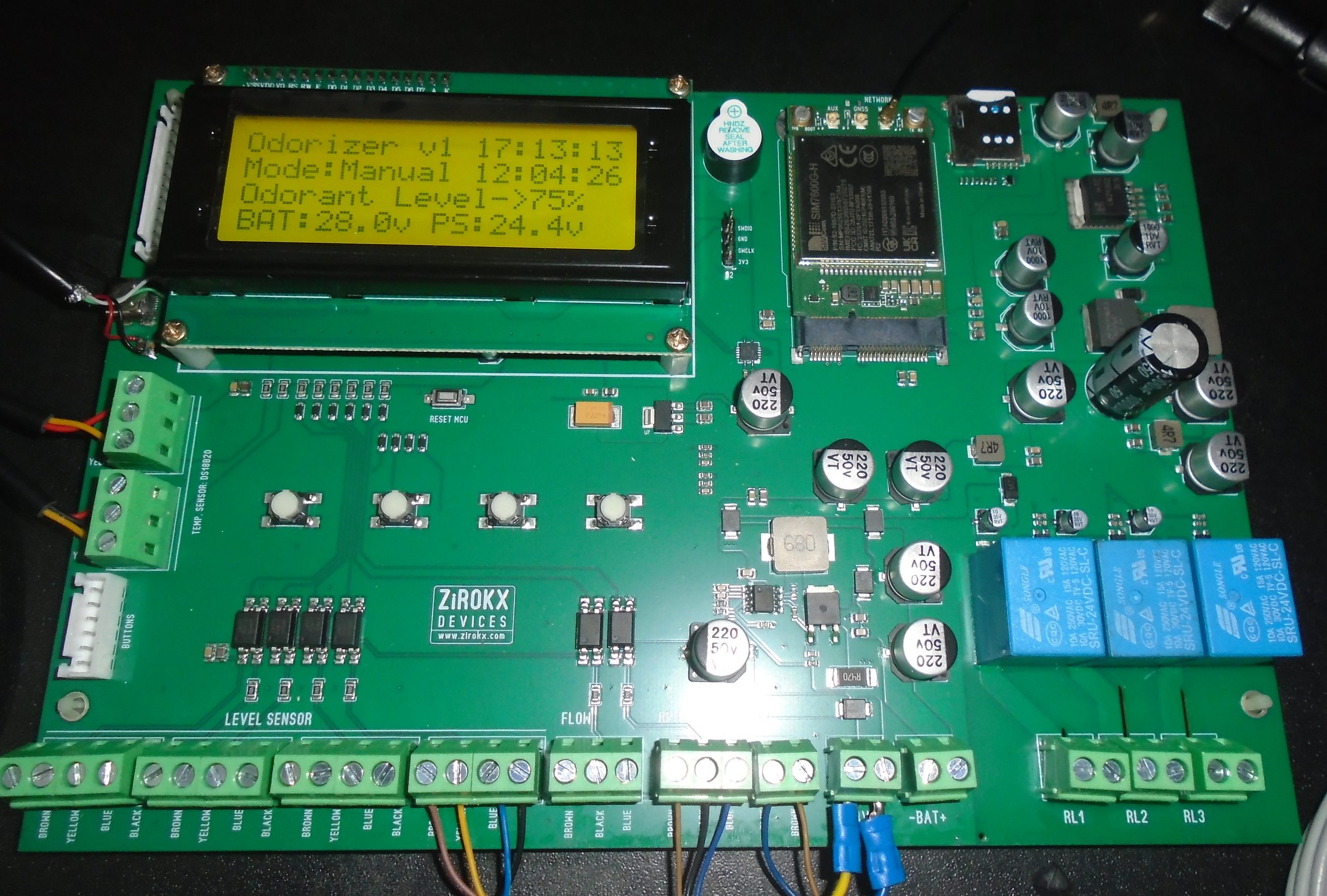
This is a custom controller developed for an industrial gas odorizer system.
The PCB brings several functions together on a single controller, including level sensors, flow monitoring, RPM feedback, relay outputs, local LCD control, and wireless IoT communication.
The objective was to provide both local control and remote monitoring of the odorizer system.
Main functions:
- Multiple level-sensor inputs
- Flow monitoring
- RPM/pulse monitoring
- Relay outputs
- LCD display
- Push-button interface
- IoT communication
- Power-management circuitry
- Field wiring connections
3-Phase Inverter Controller
Power Electronics · STM32 · PWM · Measurement
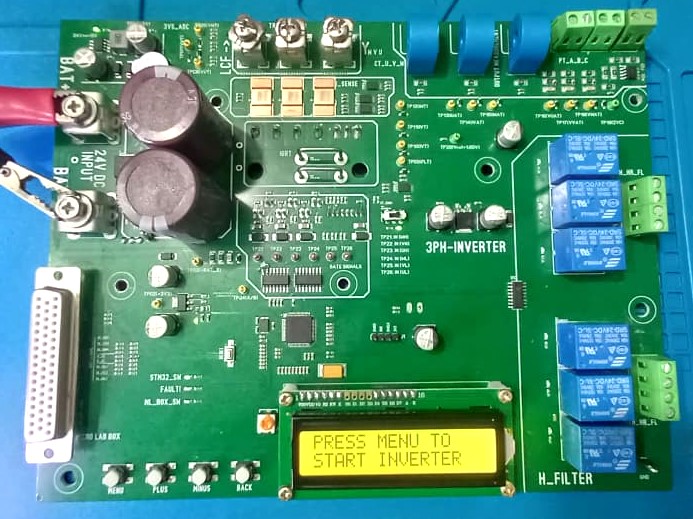
A three-phase inverter controller developed around an STM32 microcontroller.
The project combines PWM generation, voltage and current measurement, protection, temperature monitoring, and a local user interface.
The controller is designed to work together with the power stage and provide the control and measurement functions required for testing and development of a three-phase inverter.
Main functions:
- Three-phase SPWM generation
- Voltage sensing
- Current sensing
- DC-bus monitoring
- Temperature monitoring
- Protection inputs
- LCD interface
- Frequency and modulation control
- Harmonic and THD monitoring
Water ATM & Automated Dispensing System
Embedded System · Automation · RFID · IoT
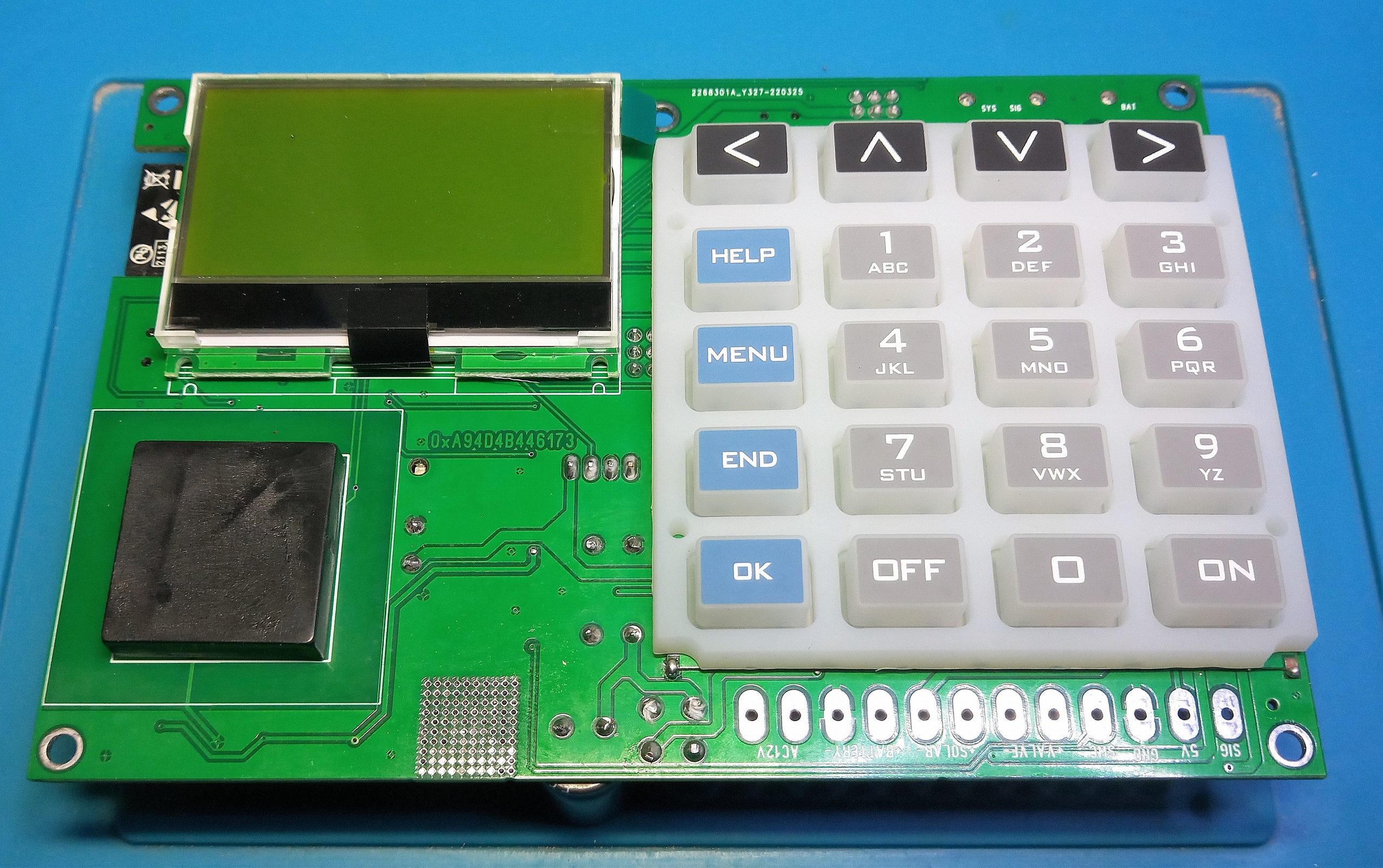
A multi-unit electronic control system developed for an automated water dispensing application.
The system is divided into different controllers for user registration/recharge, water dispensing, and central monitoring.
RFID, displays, flow sensors, pumps, valves, relays, and communication interfaces are integrated into the system.
One of the interesting parts of this project is the communication architecture between the different units while keeping the dispensing operation responsive.
Main functions:
- RFID user identification
- Recharge/registration unit
- Water dispensing control
- Flow measurement
- Pump and valve control
- RS485 communication
- Local data storage
- Central IoT controller
- Display interfaces
[Read the full project →]
What I Work On
Although the projects are different, many of them involve the same core areas of embedded electronics.
PCB Design
From simple two-layer boards to more complex embedded and mixed-signal PCBs.
Embedded Systems
Microcontroller-based hardware and firmware for dedicated electronic products.
Industrial Electronics
Controllers for machines, pumps, sensors, relays and other industrial equipment.
IoT
GSM/LTE and other communication technologies for remote monitoring and control.
Power Electronics
Inverters, battery systems, power supplies and other power-related electronic systems.
Measurement & Instrumentation
Sensor interfaces, ADCs, signal conditioning and data acquisition.
From Circuit to Working Product
A PCB is only one part of the development process.
For many projects, I work through the complete chain:
Requirement → Circuit Design → PCB → Prototype → Firmware → Testing → Product
The exact process depends on the project.
Sometimes I start with a completely new concept. In other cases, the starting point is an existing PCB, a machine that needs a new controller, or a problem with an existing electronic system.
I usually prefer to understand the complete application first and then decide how the electronics should be designed.
Some of the Hardware I Work With
My projects have involved different microcontrollers, sensors, communication modules and electronic components depending on the application.
Some examples include:
- STM32 microcontrollers
- ESP32 / ESP8266
- PIC microcontrollers
- GSM/LTE modules
- RS485
- Modbus
- MQTT
- ADC and measurement ICs
- Current and voltage sensors
- Temperature sensors
- Load cells
- LVDT sensors
- Relays
- TFT and LCD displays
- Power MOSFETs and IGBTs
- Battery and power-management circuits
I don’t try to use the same components for every project. The hardware is selected according to the actual requirements of the application.
PCB Design Software
There are many PCB design tools available today, and there is no single software that is perfect for every designer or every project.
Over the years, I have worked with different PCB design environments.
Some of the well-known options include:
I have also used Sprint-Layout extensively for many of my own PCB designs.
Sprint-Layout
I started using Sprint-Layout many years ago and have used it for a large number of my PCB projects.
It is a straightforward 2D PCB design tool and, for the type of boards I normally design with it, I find it fast and convenient.
One feature I particularly like is the ability to create my own component footprints and libraries instead of having to search for every component in an online library.
For many small and medium-sized PCB projects, a simple tool can be more practical than a very large software package.
For more complex designs, however, I also work with more advanced PCB design environments when the project requires them.
I have also made PCB design tutorials based on my experience with Sprint-Layout.
[Watch my PCB Design Tutorials →]
PCB Manufacturing
Designing the PCB is only one step.
After completing the design, manufacturing files need to be prepared, and the PCB needs to be fabricated and, where required, assembled.
Depending on the project, requirements can include:
- Gerber files
- Drill files
- BOM
- Pick-and-place files
- PCB assembly
- Component sourcing
- Prototype testing
I have worked with PCB manufacturers from different countries for different projects.
For prototype and small-batch work, I have also used JLCPCB.
The choice of manufacturer depends on the PCB specification, quantity, assembly requirements, budget and delivery requirements.
Need a Custom PCB?
If you have an electronic product or an existing machine that needs a custom controller, I can help with the PCB and embedded electronics development.
You don’t necessarily need to have a finished schematic.
You can start with something as simple as:
- A block diagram
- Hand-drawn circuit
- Existing PCB
- Product photograph
- List of sensors
- Component list
- Machine documentation
- Description of what you want the system to do
From there, the electronics can be worked out according to the requirements.
For some projects, I can work specifically on the PCB design.
For others, the work can extend to:
Circuit Design → PCB → Firmware → Sensors → Communication → IoT
Let’s Build Something
If you are working on an electronic product, industrial machine or IoT system and need a custom PCB or embedded controller, feel free to get in touch.
A little about my work
I have been working with electronics and embedded systems for many years, and most of my work has been practical rather than purely theoretical.
I enjoy working on projects where the PCB has to solve a real problem—whether that means controlling a machine, measuring a physical parameter, communicating with a remote server or bringing several different electronic systems together.
This page will continue to grow as I add more of my completed and ongoing projects.

