If you’re serious about electronics, eventually a multimeter is no longer enough.
When you need to see waveforms, debug signals, analyze PWM, inspect communication lines, or troubleshoot switching circuits, you need an oscilloscope.
Today, we review the FNIRSI 1014D Oscilloscope, a popular budget-friendly 2-in-1 unit that combines:
- Digital Oscilloscope
- DDS Signal Generator
This makes it one of the most practical entry-level tools for hobby labs, repair benches, students, and electronics enthusiasts.
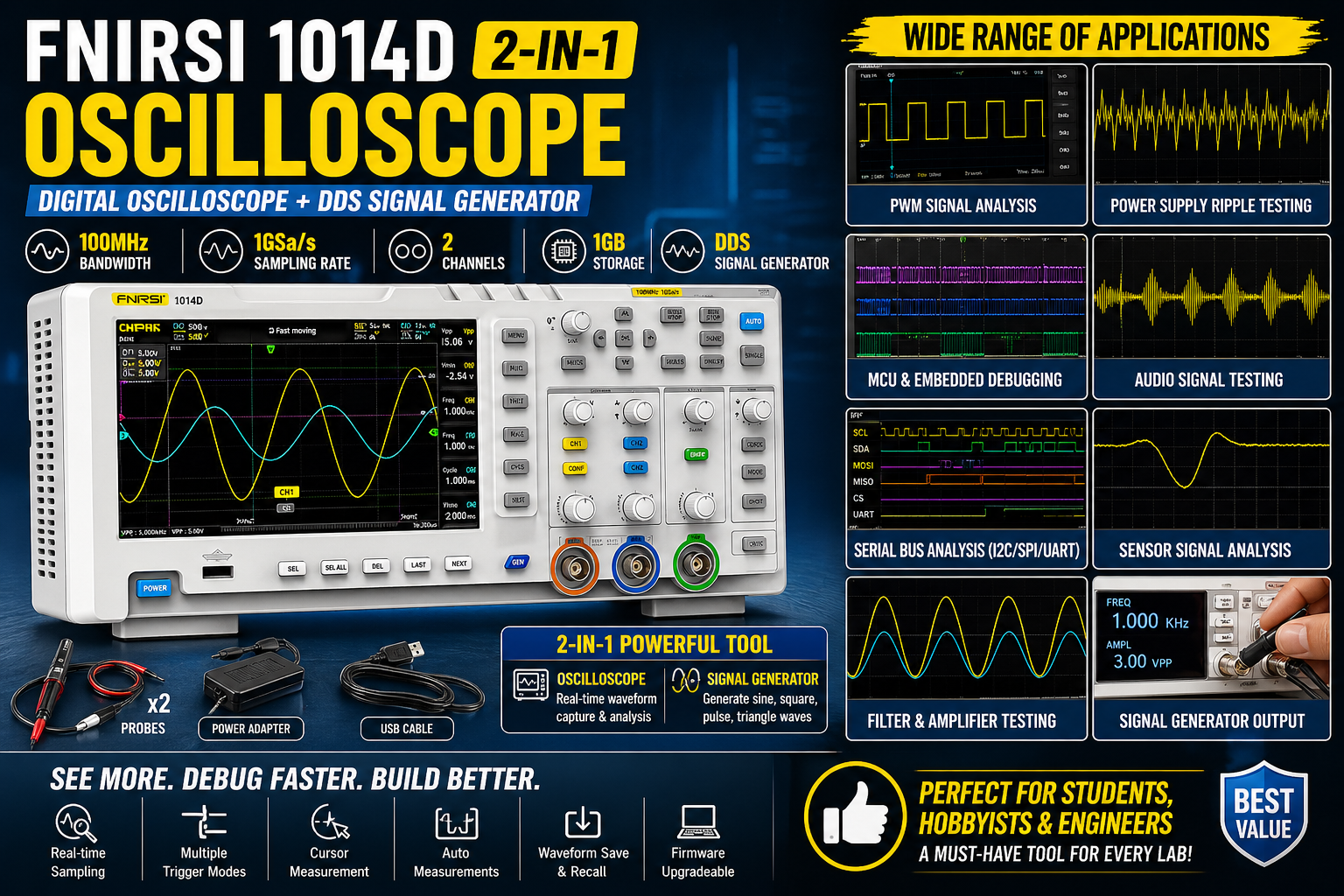
Table of Contents
🔥 Quick Verdict
- Best for: DIY electronics labs, students, repair work, embedded debugging
- Type: 2-channel digital oscilloscope + signal generator
- Bandwidth: 100MHz
- Sampling Rate: 1GSa/s
- Overall: ⭐⭐⭐⭐⭐ (4.6/5)
🧰 What You Get
Typical package includes:
- FNIRSI 1014D Oscilloscope unit
- 2 oscilloscope probes
- Power adapter
- USB cable
- User accessories
⚡ Why This Tool Is Worth Having
✔ See What Multimeters Cannot
A multimeter gives numbers.
An oscilloscope shows:
- Signal shape
- Noise
- Ripple
- Frequency behavior
- Startup glitches
- PWM duty cycle
- Serial communication waveforms
That’s a major upgrade.
✔ Built-in Signal Generator
You can generate test waveforms like:
- Sine wave
- Square wave
- Pulse wave
- Triangle wave
Great for testing circuits, amplifiers, filters, microcontroller inputs, etc.
✔ Dual Channel Advantage
Two channels allow comparing:
- Input vs output
- Clock vs data
- Gate vs drain
- Sensor vs reference
Very useful for debugging.
✔ Great Value for Home Labs
Professional scopes can cost far more.
This gives practical capability at hobby-level pricing.
✅ Pros and ❌ Cons
✔ Pros
- Affordable oscilloscope option
- Built-in signal generator
- 2 channels
- Large display
- Useful for embedded systems
- Good starter lab instrument
❌ Cons
- Not equal to premium Rigol / Siglent lab scopes
- UI may feel simpler
- Advanced users may later upgrade
🛠 Real Use Cases
Perfect for:
- Arduino / STM32 debugging
- PWM motor control analysis
- Power supply ripple checking
- Audio waveform testing
- MOSFET switching inspection
- UART / I2C signal observation
- Sensor signal analysis
- Repair bench diagnostics
⚖️ Comparison vs No Oscilloscope
| Feature | Oscilloscope | Multimeter Only |
|---|---|---|
| See Waveform | ✅ Yes | ❌ No |
| Noise Detection | ✅ Yes | ❌ No |
| PWM Analysis | ✅ Yes | ❌ No |
| Frequency Behavior | ✅ Yes | Limited |
👉 Once you own one, your troubleshooting level changes permanently.
🧠 Why I Recommend It
Many electronics hobbyists delay buying a scope too long.
That slows learning and debugging.
If you work with circuits regularly, an entry oscilloscope can save countless hours.
🛒 Final Recommendation
If you want a practical lab upgrade without spending premium money, the FNIRSI 1014D is a strong value choice.
Ideal for students, makers, and electronics workbenches.
🔗 Related Lab Essentials
- Fluke 17B+ Digital Multimeter
- Best 100W Soldering Station
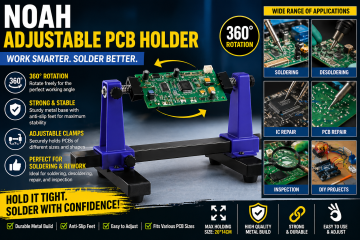
- PCB Holder Clamp Review
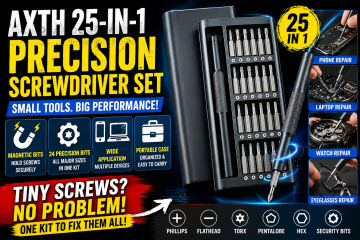
- Precision Screwdriver Set Review
- Check some of the best oscilloscopes.




0 Comments