Operational amplifiers are one of the most fundamental building blocks in analog electronics. From signal conditioning to oscillators and filters, op-amps are used in almost every electronic system. However, students often struggle to understand op-amp behavior without hands-on experimentation.
This Op-Amp Application Trainer Kit is designed to bridge that gap by providing a complete laboratory-ready platform for learning, testing, and analyzing operational amplifier circuits.
Disclaimer: Electricity is always dangerous. Proper skill is required to work with electricity. Do work at your own risk. The author will not be responsible for any misuse or harmful act. Most of the projects published here are open source; anything copying and directly posting on your website and then claiming it as yours is a prohibited and nonsensical act. A project can be open-sourced, but making a working product needs lots of effort. As products make money from a business, products are not free, but knowledge will always be free. If you want to grow your business using our products, you should pay for that. Thanks.
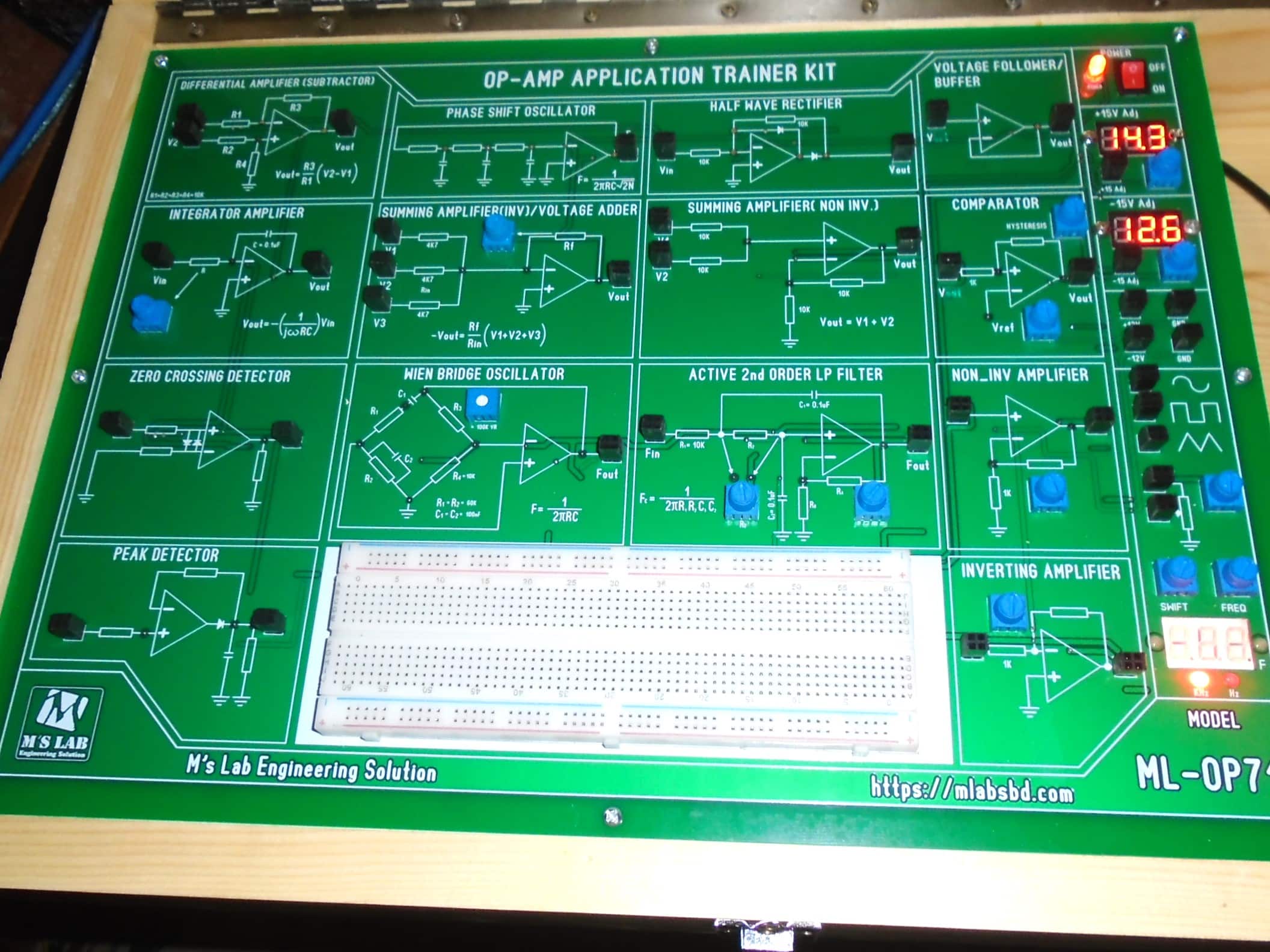
Table of Contents
Purpose of This Op-Amp Trainer Kit
Most analog electronics courses rely heavily on simulations or breadboard-based experiments, which:
- They are time-consuming to set up
- Lead to wiring mistakes
- Make troubleshooting difficult for beginners
This trainer kit was designed to:
- Demonstrate core op-amp applications clearly
- Provide pre-built, tested circuit blocks
- Allow real-time signal measurement
- Serve as a standard lab instrument for teaching
Built-in Op-Amp Applications
The trainer kit includes multiple preconfigured operational amplifier circuits, each clearly labeled and accessible through test points.
Differential Amplifier (Subtractor)
- Demonstrates voltage difference amplification
- Used for sensor signal conditioning
- Helps understand common-mode rejection
Integrator Amplifier
- Converts input voltage into a time-based output
- Used in waveform generation
- Essential for control systems
Summing Amplifier (Inverting & Non-Inverting)
- Voltage adder circuits
- Used in audio mixing and signal combination
- Demonstrates weighted input signals
Comparator with Hysteresis
- Used for level detection
- Explains Schmitt trigger behavior
- Useful for noise-immune switching circuits
Zero Crossing Detector
- Detects signal polarity changes
- Used in AC signal processing
- Important for power electronics applications
Peak Detector
- Captures peak voltage values
- Used in envelope detection
- Common in measurement systems
Voltage Follower / Buffer
- Demonstrates impedance matching
- Explains unity-gain operation
- Essential for signal isolation
Inverting and Non-Inverting Amplifiers
- Core gain-setting circuits
- Demonstrates feedback concepts
- Foundation of op-amp theory
Oscillator and Filter Circuits
Phase Shift Oscillator
- Generates sine wave signals
- Explains frequency-determining networks
- Useful for signal generation experiments
Wien Bridge Oscillator
- Produces low-distortion sine waves
- Demonstrates amplitude stabilization
- Widely used in audio applications
Active Second-Order Low-Pass Filter
- Demonstrates frequency filtering
- Helps visualize cutoff frequency and roll-off
- Essential for signal processing studies
Power Supply and Measurement Section
- Dual ±15V adjustable power supply
- Onboard digital voltage display
- Stable and low-noise operation
- Suitable for precision analog experiments
This allows students to clearly understand:
- Dual supply op-amp operation
- Output swing limitations
- Power supply effects on performance
Prototyping and Experimentation Area
A built-in solderless breadboard allows students to:
- Modify existing circuits
- Build custom op-amp applications
- Compare theory with real measurements
- Perform advanced experiments
This makes the trainer suitable for:
- Lab exams
- Final-year projects
- Research and development work
Educational Advantages
Using this op-amp trainer kit, students can learn:
- Op-amp fundamentals
- Feedback theory
- Frequency response analysis
- Signal amplification and conditioning
- Practical troubleshooting techniques
The board transforms abstract equations into visible waveforms, improving conceptual understanding.
Ideal Applications
This Op-Amp Application Trainer Kit is ideal for:
- Engineering colleges
- Polytechnic institutes
- Electronics training centers
- Analog electronics laboratories
- Self-learning students
- Instructor-led classroom demonstrations
Why This Trainer Kit Is Still Relevant
Despite advances in digital electronics, analog signal processing remains critical. Sensors, power systems, audio electronics, and control systems still depend heavily on operational amplifiers.
This trainer kit ensures students develop strong analog foundations, which are essential for advanced embedded and mixed-signal systems.
Read more:
- How to generate a pure sine wave using an Op-Amp
- How to make a high voltage DC voltmeter (1000V+ !!!)
- How to measure floating high voltage AC with an Op-Amp
Conclusion
The Op-Amp Application Trainer Kit is a complete and practical solution for teaching analog electronics. By combining pre-built circuits, measurement access, and prototyping space, it provides an effective, reliable, and professional laboratory experience.
Liked this article? Subscribe to our newsletter:
or,
Visit LabProjectsBD.com for more inspiring projects and tutorials.
Thank you!



2 Comments
mohammed · 05/02/2026 at 10:32 am
Op-Amp Trainer Kit qty=3pcs
MKDas · 05/02/2026 at 12:18 pm
please communicate through whatsapp or email