🌐 এই লেখাটি বাংলায় পড়ুন: বাংলা সংস্করণ →
Online marketplaces sell many LiFePO4 cells as “Grade A, brand new, 100% capacity”. In reality some are used, recycled, or far below their label. After you have paid, the only way to be sure is a LiFePO4 cell capacity test. This guide covers the warning signs, how to test at home, and how to match cells for a pack.
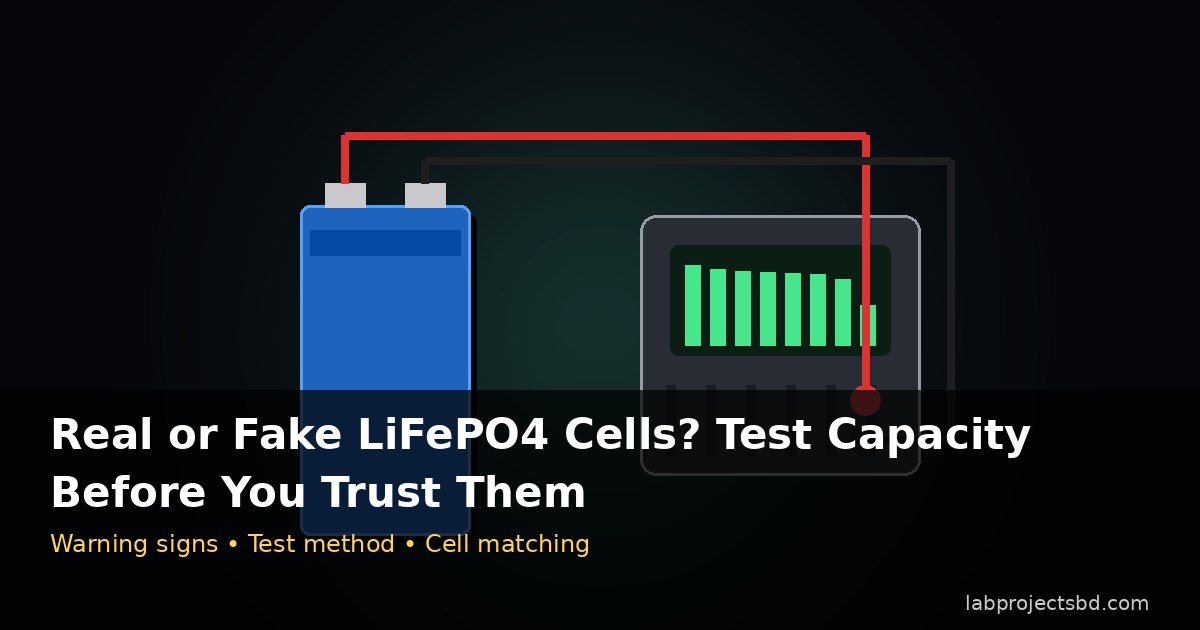
Table of Contents
7 signs of fake or used LiFePO4 cells
- An unusually low price: far below market almost always means a problem.
- Ground-off QR codes or new stickers: often used to hide an old cell’s history.
- Weld marks or scratches on the terminals: busbars were welded before, so the cell is used.
- Swollen or dented cases: never buy these.
- Different production dates or batches: the cells won’t match.
- Lower weight than the datasheet: compare with the datasheet weight for that model.
- The seller can’t provide a datasheet or test report.
For more tricks for spotting counterfeit parts in general, see our guide to spotting fake electronic components.
What you need for a capacity test
| Tool | Purpose | Notes |
|---|---|---|
| CC/CV charger or bench supply | Fully charge the cell to 3.65V | Must have an adjustable current limit |
| Electronic load (DC load tester) | Discharge at a set current and count Ah | Fan-cooled 150–300W models are popular; set the cut-off voltage |
| Multimeter | Check voltages | Cross-check the load’s display |
| Thick wires, good clips | Low voltage drop | Thin wires give wrong readings |
| IR meter (optional) | Internal resistance | An AC IR meter gives quick results |
LiFePO4 cell capacity test, step by step
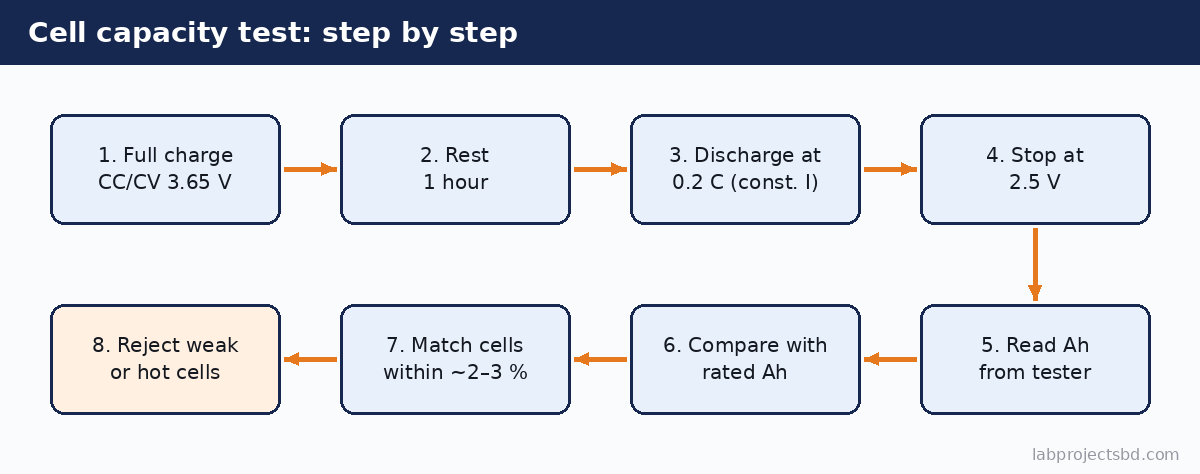
- Full charge: charge at 3.65V CV and stop when the current falls to 5% of rated Ah (5A for a 100Ah cell).
- Rest: leave it for 1 hour.
- Discharge: use the electronic load in constant-current mode at 0.2C (20A for a 100Ah cell). A smaller load at lower current also works; it just takes longer.
- Cut-off: set the load to stop at 2.5V.
- Read the result: note the total Ah or Wh on the display.
- Compare: check it against the rated Ah.
- Watch the temperature: reject any cell that gets unusually hot during the test.
To test a complete 12.8V pack, run a known load (bulbs or a fan) from the IPS and measure Ah with a DC shunt meter. This also includes inverter losses, so it is closer to real use.
Why voltage alone doesn’t tell you the charge
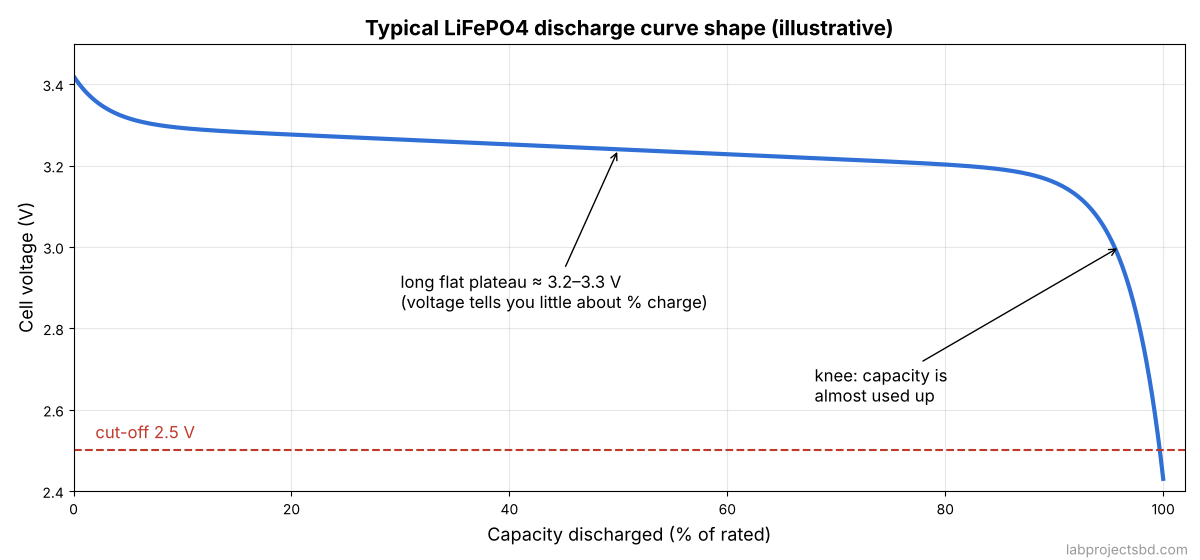
The LiFePO4 discharge curve is very flat: for most of the discharge the voltage sits at 3.2–3.3V, then drops sharply at the end. So a voltage reading cannot tell you how much charge is left or what the capacity is. Counting Ah is the only reliable method.
Measure internal resistance (IR)
Good cells of the same model have similar IR, within the datasheet limit. A cell with clearly higher IR than the others is weak or old. For a DIY way to measure it, see our battery internal impedance guide.
Judging the results and matching cells
| Measured capacity (vs rated) | Meaning | Action |
|---|---|---|
| 100% or more | Probably new and good | Use in the pack |
| 90–99% | Acceptable; test conditions may account for it | Group cells from the same range |
| 80–89% | Probably used or low grade | Talk to the seller; use for less critical jobs |
| Below 80% | Fake or very old | Return it |
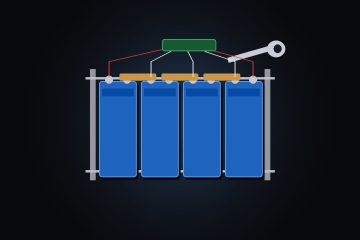
- Keep cells in one pack within 2–3% of each other. A pack’s capacity equals its weakest cell.
- After testing, top-balance again before building the pack (see the DIY pack guide).
- Keep the test report and photos. They help with warranty claims.
Testing a whole IPS pack under real use
If you can’t test individual cells (for example a sealed ready-made battery), test the whole system:
- Fully charge the battery and let it rest for 1 hour.
- Fit a DC shunt meter (a volt-amp-Ah meter with a 100A shunt) on the battery negative and reset it.
- Switch off the mains and run a known load from the IPS (for example 300W of bulbs or a heater).
- Run until the IPS shuts down on low battery, and note the total Ah and Wh.
- A 12.8V 100Ah battery should usually give 80–95Ah, depending on the IPS cut-off. Much less points to a cell or BMS problem.
This test also captures inverter losses. Compare the time and Wh with your backup calculation.
Are Grade B or used cells always bad?
Not all used cells are bad. Cells taken from large energy-storage projects are often in good condition and much cheaper. The problem is used cells sold as new at new-cell prices. So match your expectations to the price, and whatever cells you buy, test and match them.
A simple test report template
| Cell | Start voltage | IR (mΩ) | Measured Ah | % of rated | Max temp during test | Notes |
|---|---|---|---|---|---|---|
| 1 | 3.28V | – | – | – | – | |
| 2 | 3.28V | – | – | – | – | |
| 3 | 3.27V | – | – | – | – | |
| 4 | 3.28V | – | – | – | – |
To understand why different IR methods (DC load vs AC) give different numbers, see Battery University BU-902. For the characteristics of LiFePO4 chemistry, see BU-205.
Common myths
- “3.3V means the cell is good”: a bad cell also rests at 3.3V; only a discharge test shows capacity.
- “I can measure IR with the multimeter’s resistance mode”: no; it can damage the meter and the reading is meaningless.
- “One full discharge test wears out the cell”: LiFePO4 handles thousands of cycles; one test makes no difference.
- “A higher price means genuine”: used cells are sometimes sold at new prices; only a test proves it.
- “Grade A printed on the case is proof”: anyone can print a sticker.
Measuring IR without a meter (the ΔV/ΔI method)
Without an AC IR meter, you can measure DC resistance with the electronic load and a good multimeter:
- Put the multimeter probes directly on the cell terminals (not on the load wires).
- Run a low current (e.g. 5A) for 10 seconds and note the voltage: V1.
- Then run a high current (e.g. 25A) for 10 seconds and note the voltage: V2.
- IR = (V1 − V2) ÷ (I2 − I1). Example: 3.300V and 3.290V gives 0.010V ÷ 20A = 0.5mΩ.
- Measure all four cells the same way; what matters is that the values are close. This DC value usually reads higher than an AC meter, so only compare results taken with the same method.
What to ask the seller before you pay
- What is the cell brand, model and datasheet?
- What is the production date, and are all cells from the same batch?
- Are the cells new or used? What exactly does the seller mean by “Grade”?
- Can they provide a capacity and IR test report?
- What is the return or replacement policy if the capacity tests low?
If the cells will sit unused for a few weeks after testing, store them at about 50% charge (about 3.3V at rest) in a cool place. Long storage at full charge or completely empty speeds up ageing. Top-balance again just before building the pack, so any small differences that developed during storage are removed.
- LiFePO4 battery backup time
- DIY 12V LiFePO4 battery pack
- Real or fake cells? Capacity test (this article)
- Charge controller settings for LiFePO4
- Off-grid solar home system design
Frequently asked questions
Can a small USB load tester test big cells?
Yes, but at low current a 100Ah cell takes a very long time. A 150W or larger electronic load is much more practical.
Is it a problem if I measure more than the rated capacity?
No. Many new cells deliver slightly more than rated. If the difference is large, check your meter’s calibration.
Can I trust the capacity printed on the cell?
Don’t rely on the label alone. Only an independent test is reliable.
Can I get this test done in Bangladesh or India?
Some battery and solar service centres offer it. Owning a load tester is worth it in the long run if you buy cells often.
What if one cell hits 2.5V much earlier than the others?
That is the pack’s weakest cell. If its capacity is 3–5% below the rest, replace it or report it to the seller.
What if I don’t have an electronic load?
A 12V bulb of known wattage plus a shunt meter can also count Ah, though the current drifts a little so the result is less precise.
Conclusion
A LiFePO4 cell capacity test saves both money and future trouble. Right after buying: full charge, 0.2C discharge to 2.5V, count the Ah, compare IR, and use only matched cells in a pack.
Need battery testing, a test rig or a custom pack? We design custom PCBs, firmware and complete working prototypes for students and companies. Message us on WhatsApp or use the contact form. You can write in Bangla or English.




0 Comments