🌐 এই লেখাটি বাংলায় পড়ুন: বাংলা সংস্করণ →
When the power goes, everyone asks the same question: how many hours will the battery last? You can work out LiFePO4 battery backup time yourself in two minutes instead of trusting a shopkeeper’s guess. This guide gives one simple formula, worked examples with typical Bangladeshi and Indian home loads, and the reverse calculation to choose how many Ah to buy.
Table of Contents
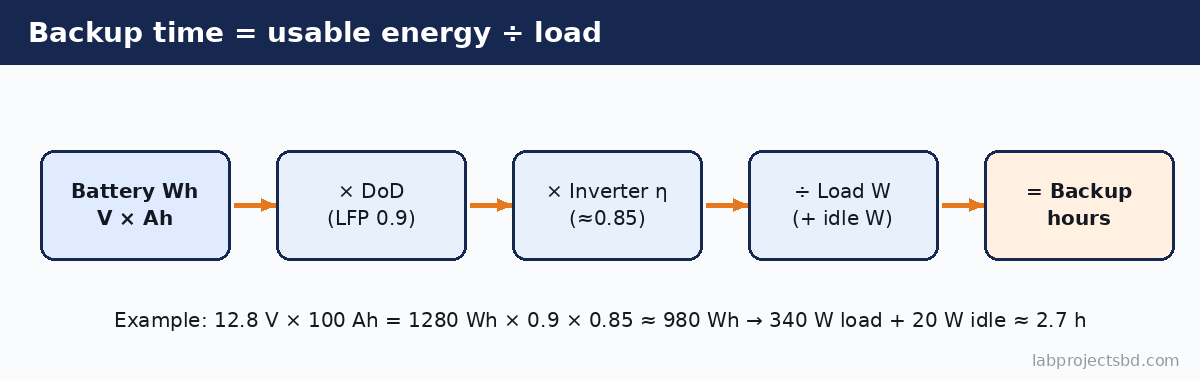
The LiFePO4 battery backup time formula
Backup (hours) = Battery V × Ah × DoD × inverter efficiency ÷ (load W + inverter idle W)
- V × Ah = stored energy in Wh. 12.8V × 100Ah = 1,280Wh.
- DoD (depth of discharge): how much of the battery you use. LiFePO4 can safely use 80–90%; lead-acid only about 50% for a long life.
- Inverter efficiency: about 80–85% for a typical home IPS. The rest becomes heat.
- Idle draw: the inverter itself uses 15–30W even with no load. Most people forget this.
How many watts does your home actually use?
Check each appliance label or manual for accurate figures. Typical values:
| Appliance | Typical watts | Note |
|---|---|---|
| Standard ceiling fan | 60–80W | The regulator barely reduces it |
| BLDC ceiling fan | 28–35W | The best backup investment |
| LED bulb / tube | 9–20W | Far less than CFL or tube lights |
| Wi-Fi router + ONU | 15–25W | Runs all night, so it matters |
| 32–43″ LED TV | 40–80W | Lower brightness saves power |
| Laptop charging | 45–90W | Desktop PC 150W+ |
| Fridge (running) | 100–150W | Starting current is several times higher; avoid on small IPS |
Worked example: 3 fans, 6 lights, router and TV
Say you run 3 standard fans (70W), 6 LED lights (10W), a router (20W) and a TV (50W). Total load = 210 + 60 + 20 + 50 = 340W. Add 20W inverter idle draw.
| Battery | Usable energy | Backup at 340W | Backup with BLDC fans (220W) |
|---|---|---|---|
| 12.8V 100Ah LiFePO4 | 1,280 × 0.9 × 0.85 ≈ 980Wh | 980 ÷ 360 ≈ 2.7 h | 980 ÷ 240 ≈ 4.1 h |
| 12.8V 150Ah LiFePO4 | ≈ 1,470Wh | ≈ 4.1 h | ≈ 6.1 h |
| 25.6V 100Ah LiFePO4 | ≈ 1,960Wh | ≈ 5.4 h | ≈ 8.2 h |
| 12V 150Ah tubular (50% DoD) | 1,800 × 0.5 × 0.85 ≈ 765Wh | ≈ 2.1 h | ≈ 3.2 h |
Notice that a 100Ah LiFePO4 gives more usable energy than a 150Ah lead-acid battery, because using more than half of a lead-acid battery shortens its life quickly. And switching three fans to BLDC alone gives about 1.5× more backup.
Reverse calculation: how many Ah do you need?
Required Ah = (load W + idle W) × hours ÷ (battery V × DoD × efficiency)
Example: 340W for 4 hours on a 12.8V system: (340 + 20) × 4 ÷ (12.8 × 0.9 × 0.85) = 1,440 ÷ 9.79 ≈ 147Ah. Buy 150Ah, or go to a 24V system with 100Ah.
Do the same calculation online with our battery backup time calculator and battery pack calculator.
Should you choose 12V or 24V?
- Load under 400–500W with an IPS up to 1 kVA: 12.8V is fine.
- Load above 600W: choose 24V or 48V. The same watts need half the current, so cables are smaller and the BMS and fuse are less stressed.
- Example: an 800W load draws about 78A at 12V but only about 39A at 24V.
- If you plan to add solar later, 24V gets more out of an MPPT charge controller.
For price reference: in Bangladesh a 12V 100Ah LiFePO4 IPS battery was listed at ৳25,000 (BDStall). In India, a 2026 guide puts 12V 100Ah lithium inverter batteries at about ₹18,000–₹28,000 (Lento India). Prices vary with brand and warranty.
6 practical tips to stretch backup
- Replace standard fans with BLDC fans. This makes the biggest difference.
- Keep big loads such as TVs and laptops on a separate circuit during load-shedding.
- Choose an inverter with low idle draw; 20W idle over an 8-hour night wastes 160Wh.
- Keep the battery in a cool, ventilated place.
- Check that your IPS charges at LiFePO4-safe voltages. Details: LiFePO4 Battery for IPS.
- Run one full discharge test on a new battery and note the real backup time, so you can compare later.
Frequent outages: how long does recharging take?
Backup time is only half the story. How fast the battery refills after power returns matters too. With several outages a day, a slow charger may not refill the battery before the next one.
Charge time (hours) ≈ Ah used ÷ charge current × 1.1
- If 90Ah of a 12.8V 100Ah battery is used, a 15A charger needs about 90 ÷ 15 × 1.1 ≈ 6.6 hours.
- With a 25A charger the same battery refills in about 4 hours. LiFePO4 does not need a long absorption stage like lead-acid, so it charges quickly right to the end.
- Lead-acid takes a long time to put in the last 20%. With frequent outages it never fully charges, which is a major cause of sulphation.
- Check the IPS manual for the charger current, and use our battery charging time calculator.
Does backup drop over time?
Yes, every battery slowly loses capacity. LiFePO4’s advantage is that it tolerates many more cycles than lead-acid and fades more slowly (Battery University BU-205). Three things shorten its life: heat, sitting at 100% all the time (high float), and repeated deep discharges. Measure the backup time once when the battery is new, then again once a year. When backup falls to 70–80% of the new value, start planning a replacement.
| Do this | Why |
|---|---|
| Keep the battery at 25–35°C, out of the sun and away from the inverter’s hot air | Chemical ageing speeds up as temperature rises |
| Set the IPS float to 13.4–13.6V | Less time sitting at 100% |
| Low-voltage cut-off at 11.6–12V | Avoids deep discharge and relying on the BMS |
| Check terminal tightness every 6 months | Loose lugs heat up, cause voltage drop and BMS trips |
Common myths
- “More Ah always means more backup”: check the voltage too. 12.8V 100Ah (1,280Wh) and 25.6V 100Ah (2,560Wh) are very different.
- “I had 150Ah lead-acid, so I need 150Ah LiFePO4”: no. LiFePO4 has more usable capacity, so 100Ah is usually enough.
- “A bigger IPS gives more backup”: wrong. The IPS VA rating only sets the maximum load; backup depends on the battery’s Wh.
- “Turning the fan regulator down halves the power”: with standard fans the saving is small. BLDC fans are where the real saving is.
- “With the TV off at night the IPS uses nothing”: the IPS idle draw keeps running all night.
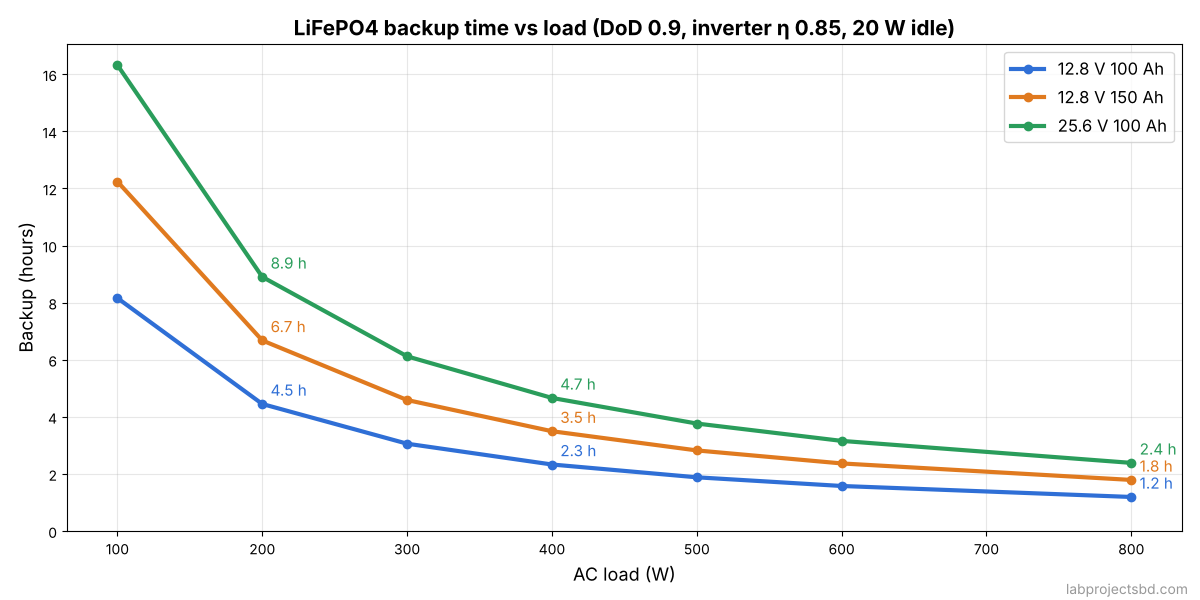
Quick reference: backup on common batteries
| Load (incl. 20W idle) | 12.8V 100Ah | 12.8V 150Ah | 25.6V 100Ah |
|---|---|---|---|
| 100W | ≈ 8.2 h | ≈ 12.2 h | ≈ 16.3 h |
| 200W | ≈ 4.5 h | ≈ 6.7 h | ≈ 8.9 h |
| 400W | ≈ 2.3 h | ≈ 3.5 h | ≈ 4.7 h |
| 800W | Not suitable | ≈ 1.8 h | ≈ 2.4 h |
- LiFePO4 battery backup time (this article)
- DIY 12V LiFePO4 battery pack
- Real or fake cells? Capacity test
- Charge controller settings for LiFePO4
- Off-grid solar home system design
Frequently asked questions
How long will one fan run on a 12.8V 100Ah LiFePO4?
A standard 70W fan plus 20W idle: about 980 ÷ 90 ≈ 10–11 hours. A 30W BLDC fan: about 20 hours.
Do I get the full Wh printed on the battery?
No. Depending on the BMS and your settings, 80–90% is usable, and the inverter loses another 15–20%. That is why the formula includes both DoD and efficiency.
Can my old IPS run a LiFePO4 battery?
Many can, but check the charge and cut-off voltages first. See our detailed guide.
Why am I getting less backup than calculated?
Usually the load is higher than the labels say, the inverter is less efficient, the battery is hot, or its real capacity is lower than rated. A capacity test catches the last one.
Is the calculation the same in India?
Yes. India also uses 230V/50Hz with similar appliances, so the formula and examples apply directly.
Can a fridge run on a LiFePO4 IPS?
Yes, if the IPS is pure sine and can handle the starting current (usually 1 kVA or more). A fridge cycles on and off, so budget about 50–80W on average.
Will a 12V IPS work with a 24V battery?
No. The IPS battery voltage must match. A 24V battery needs a 24V IPS.
Conclusion
LiFePO4 battery backup time is simple: Wh × DoD × efficiency ÷ load. Measure your real load, include the idle draw, and consider 24V for larger loads. The cheapest way to get more backup is usually to reduce the load, especially by switching to BLDC fans, rather than buying a bigger battery.
Need a custom LiFePO4 pack, BMS or solar-IPS solution? We design custom PCBs, firmware and complete working prototypes for students and companies. Message us on WhatsApp or use the contact form. You can write in Bangla or English.




0 Comments