A LiFePO4 battery for IPS is one of the most popular upgrades in Bangladeshi homes right now. It is lighter, lasts years longer and gives more usable backup than a tubular lead-acid battery. But an IPS designed for lead-acid does not automatically suit a lithium battery. A wrong charge voltage, a weak BMS or a missing fuse can trip the battery during load-shedding or, worse, damage it. This guide shows what to measure and calculate before you swap, and how to wire the new pack safely.
Table of Contents
Why use a LiFePO4 battery for IPS?
| Feature (typical) | 12 V 100–150 Ah tubular lead-acid | 12.8 V 100 Ah LiFePO4 |
|---|---|---|
| Recommended depth of discharge | ≈ 50 % for long life | 80–90 % |
| Usable energy | ≈ 600–900 Wh | ≈ 1,000–1,150 Wh |
| Cycle life | Hundreds to ~1,500 at moderate DoD | Thousands (sellers quote 3,000–6,000+) |
| Weight | 40–60 kg | ≈ 11–14 kg |
| Maintenance | Distilled water top-up, acid fumes | None |
| Charge efficiency | Lower (gassing, long absorption) | High: charges faster on the same current |
| Main risk | Sulphation if left discharged | Cell imbalance, BMS trips, fake cell capacity |
LiFePO4 (lithium iron phosphate) is also one of the safest lithium chemistries thermally, which is why it is used for home storage. For background on the chemistries, see Battery University BU-205. Local prices have come down; for example, a 12 V 100 Ah LiFePO4 pack for IPS was listed at ৳25,000 on BDStall in November 2026.
The real problem: your IPS charger was designed for lead-acid
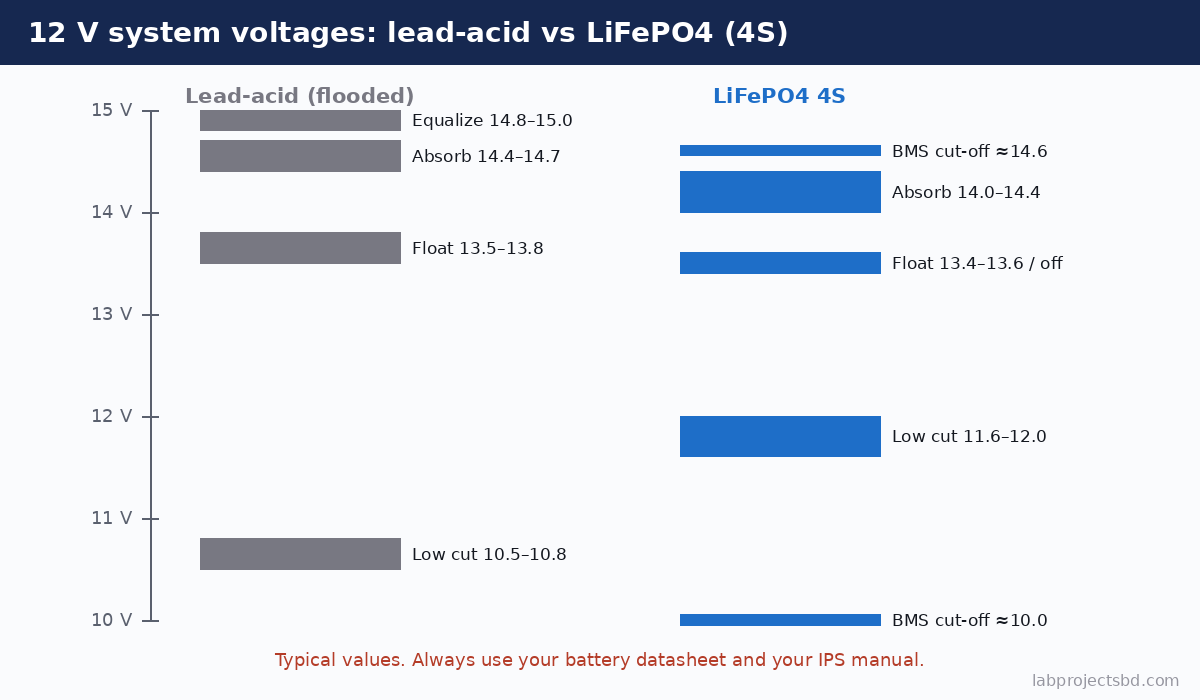
Lead-acid batteries like a high absorption voltage, a permanent float charge and sometimes an equalise or boost charge near 15 V. See BU-403 Charging Lead Acid. LiFePO4 wants none of that:
- Too high a charge voltage pushes one cell above ~3.65 V. The BMS then disconnects the pack, and some IPS units show battery fault or switch off.
- A constant float at 13.6–13.8 V keeps the pack at 100 % all the time. LiFePO4 survives this, but it ages faster in a hot room.
- A low cut-off of 10.5 V is far too low for LiFePO4. The pack is almost empty near 12 V, so the BMS hard cut-off (≈10 V) trips first instead of the IPS stopping gracefully.
Many newer IPS and hybrid inverters sold in Bangladesh have a Lithium / LiFePO4 battery type in their menu. If yours does, most of this problem is solved: select it and check the values. If it does not, measure before you buy.
The 3 voltages to check on your IPS
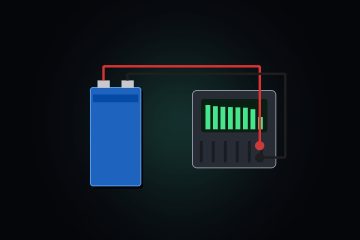
Use a good digital multimeter on the battery terminals. (New to that? See how to use a multimeter.) Record:
| Measurement | How | OK for LiFePO4 (4S, 12.8 V) | Action if not OK |
|---|---|---|---|
| Maximum charge voltage | Mains on, old battery discharged a bit, watch the highest voltage over 1–2 hours | 14.0–14.4 V (≤ 14.6 V absolute) | Select a lower battery type (e.g. SMF/VRLA) or add a dedicated LiFePO4 charger |
| Float voltage | After the charger settles (hours later) | 13.4–13.6 V, or charging stops | 13.8 V is acceptable if the room stays cool; above that, change the mode |
| Low-battery cut-off | Check the manual or settings; test with a load and a fresh battery | 11.6–12.0 V (≈ 2.9–3.0 V/cell) | Adjust it if the IPS allows; otherwise the BMS will be doing the cut-off |
If your IPS has an equalise or boost mode that goes to 14.8–15 V, do not connect LiFePO4 unless you can disable it.
Sizing the BMS for your IPS
The BMS carries all of the IPS’s DC current. Work out the worst case:
IDC = Pout ÷ (Vbattery × η)
Example: a 1,000 VA IPS can deliver about 800 W. Near the end of discharge the battery is about 12 V and inverter efficiency about 85 %: 800 ÷ (12 × 0.85) ≈ 78 A continuous.
- Choose a BMS rated ≥ 100 A continuous for a 1 kVA IPS. That gives about 25 % margin, so the MOSFETs run cooler in summer.
- Check the peak/surge rating and its time limit. Fridge and pump motors draw 2–3× current for a short time when they start.
- Check the charge current limit. Most IPS chargers give 10–20 A, which is gentle (0.1–0.2 C) for a 100 Ah pack.
- Prefer a pack with active balancing or at least passive balancing of ≥ 50 mA, and a temperature sensor.
- Smart BMS with Bluetooth lets you see each cell’s voltage; very useful when diagnosing trips.
To pick capacity and backup time, use our battery pack calculator and battery backup time calculator.
Fuse, breaker and cable: the part people skip
A LiFePO4 pack can deliver thousands of amps into a short circuit, much more than an old lead-acid battery with high internal resistance. Protection is not optional.
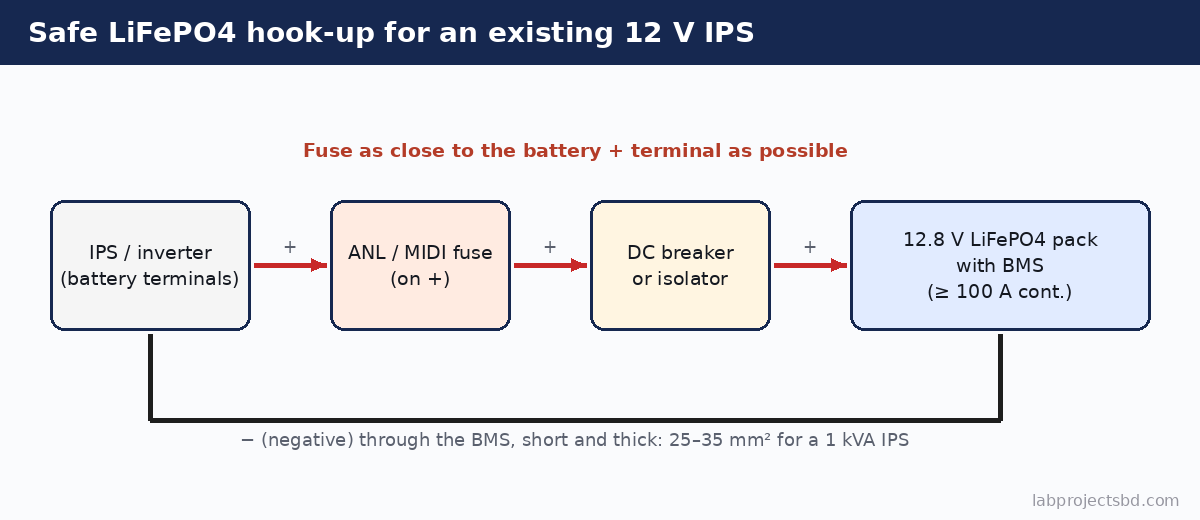
- Fuse: an ANL or MIDI fuse rated about 1.25 × the maximum continuous current (≈ 100–125 A for a 1 kVA IPS), as close to the battery + terminal as possible. Use a fuse with a DC rating, not a glass or car blade fuse.
- Isolator: a DC breaker or battery switch so you can disconnect safely for service.
- Cable: 25 mm² copper for a short (< 1.5 m) run at 1 kVA; 35 mm² for longer runs. Keep the voltage drop under about 2 %. Our wire size calculator does the maths.
- Lugs: crimped (not soldered) copper lugs, tightened to the battery maker’s torque. Loose lugs cause heat and BMS trips.
- Never connect a LiFePO4 pack in parallel with the old lead-acid battery. They have different voltage curves.
Step-by-step: replacing lead-acid with LiFePO4
- Read the IPS manual. Look for a battery-type setting (Lithium/LiFePO4) and the charge current.
- Measure the charge, float and cut-off voltages as shown above.
- Choose the pack: 12.8 V, enough Ah for your backup time, a BMS of ≥ 100 A for 1 kVA (scale for larger IPS), with balancing.
- Fit the fuse, isolator and new cables before connecting anything.
- Disconnect mains, switch the IPS off, remove the old battery (keep it upright; it contains acid).
- Connect the new pack: + through the fuse and isolator, then −. Check polarity twice. Reverse polarity can destroy the IPS.
- Select the lithium battery type if available, switch on, and watch the first full charge with your multimeter or the smart BMS app.
- Run one controlled discharge with your normal load and note the backup time. This is your baseline for spotting capacity loss later.
Bought cells from a marketplace? Test their capacity and internal resistance before you trust them. Our battery internal impedance guide shows a DIY method, and this guide explains how fakes are sold.
Is it worth the money? A quick cost-per-cycle check
The upfront price is higher, so compare what each battery costs per kWh you actually use over its life:
Cost per kWh = battery price ÷ (usable kWh per cycle × number of cycles)
Example with the ৳25,000 listing above: about 1.1 kWh usable per cycle, and if it delivers even 3,000 cycles, that is 25,000 ÷ (1.1 × 3,000) ≈ ৳7.6 per kWh of backup energy. Do the same sum with your lead-acid quote, using its usable energy at 50 % depth of discharge and a realistic cycle life in a hot room. In daily-cycling homes and solar systems, LiFePO4 usually wins clearly. In a home where load-shedding is rare, the battery mostly sits in float, so the advantage is smaller; then lower weight and zero maintenance may be the main reasons to switch.
Also budget for the extras: a correctly rated fuse, isolator, new cables and lugs. These are a small part of the total, but they decide whether the installation is safe.
Frequently asked questions
Can I use a LiFePO4 battery with any IPS?
Physically yes, but only safely if the charge voltage stays at or below about 14.4 V, there is no 15 V equalise mode, and the BMS can handle the IPS current. IPS units with a lithium setting are the easiest.
Why does my IPS show ‘battery low’ or switch off with a full LiFePO4 pack?
Usually the BMS has tripped. Common causes are over-current (the BMS is too small), one cell over-charged (charge voltage too high or poor balancing) or a loose cable lug. A smart BMS app shows which one.
Is a 100 Ah LiFePO4 equal to a 150 Ah lead-acid battery?
Often, in usable energy, yes, because you can use 80–90 % of LiFePO4 but only about half of lead-acid for a long life. The exact match depends on your load and the cut-off voltage.
Does heat affect LiFePO4?
Yes. Keep the pack in a shaded, ventilated place, ideally below about 40 °C. Heat shortens the life of every battery chemistry.
Can I build my own pack from 3.2 V cells?
Yes, with four prismatic cells in series, busbars, a correctly rated BMS and top-balancing before first use. Buy cells from a trusted seller and capacity-test them. Fake grade-A cells are common.
Conclusion
A LiFePO4 battery for IPS is an excellent upgrade, if the IPS charges it like a lithium battery. Check three voltages (charge, float, cut-off), choose a BMS with real margin, and add a proper DC fuse and thick cables. Do those things and the new pack should outlast several lead-acid batteries. Planning to add solar later? See our rooftop solar sizing guide for Bangladesh. For the bigger picture, read IPS vs stabilizer vs UPS.
Need a custom LiFePO4 pack, BMS, charger or IPS modification? We design custom PCBs, firmware and complete working prototypes for students and companies. Message us on WhatsApp or use the contact form. You can write in Bangla or English.




0 Comments