🌐 এই লেখাটি বাংলায় পড়ুন: বাংলা সংস্করণ →
Solar home systems are nothing new in Bangladesh: IDCOL’s programme installed over six million of them (The Business Standard). Today’s systems are bigger and better: large panels, MPPT controllers and long-life LiFePO4 batteries. This guide walks through a complete off-grid solar home system design for a village home, a shop or any area with frequent load-shedding, with a worked example.
Table of Contents
The main parts of an off-grid solar home system design
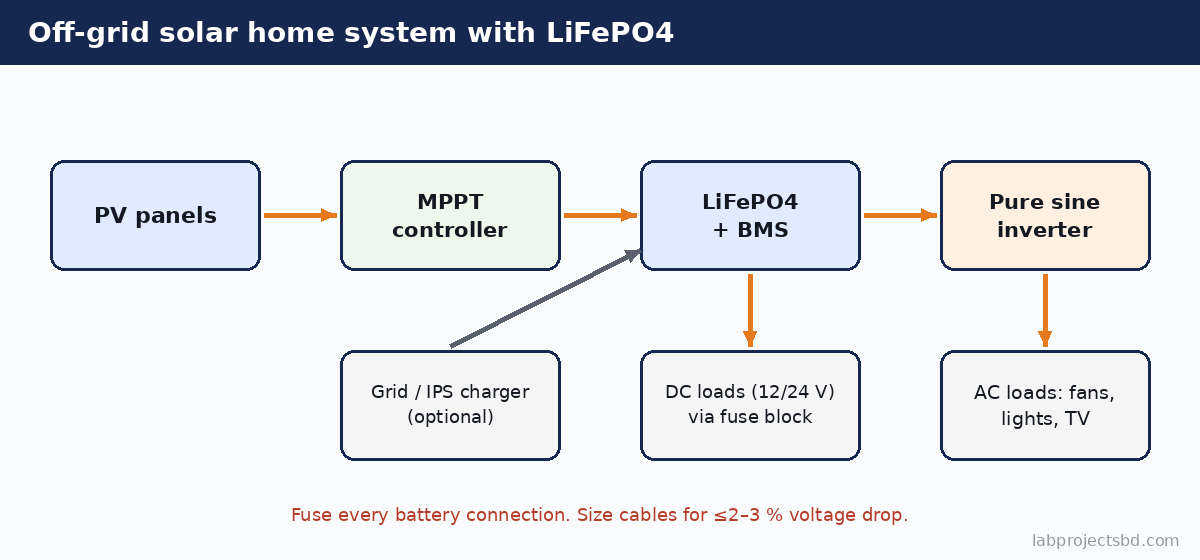
- Solar panels (PV): make DC power in daylight.
- MPPT charge controller: takes maximum power from the panels and charges the battery safely.
- LiFePO4 battery + BMS: stores energy for the night.
- Pure sine inverter: makes 230V AC for fans, lights and TV.
- Optional: where grid power exists, an IPS/charger tops up the battery on cloudy days.
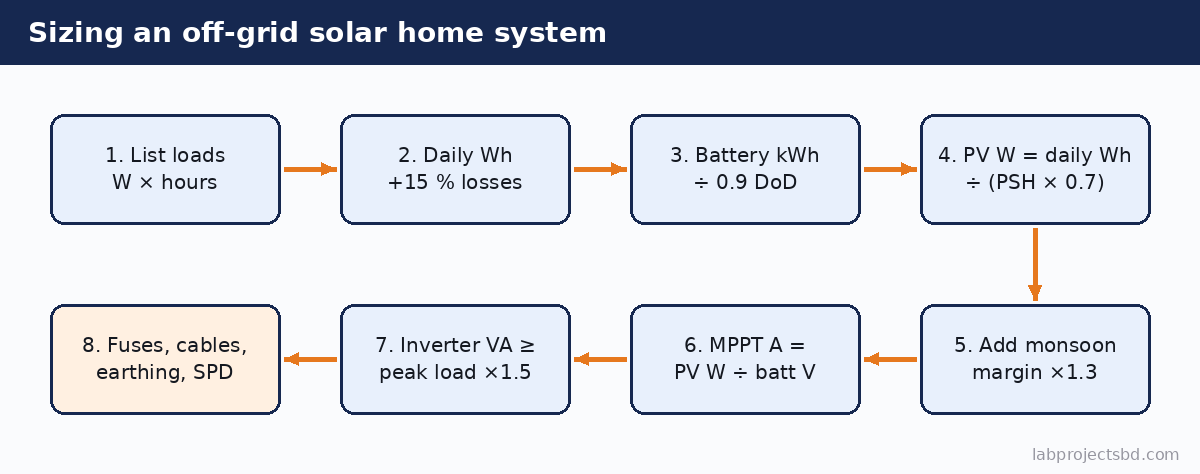
Step 1: Load list and daily energy
Example: a village home (or small shop):
| Load | Watts | Qty | Hours/day | Wh/day |
|---|---|---|---|---|
| LED light | 10W | 4 | 6 | 240 |
| BLDC fan | 30W | 2 | 10 | 600 |
| LED TV | 50W | 1 | 4 | 200 |
| Phone charging and router | – | – | – | 100 |
| Total | 1,140Wh |
Add 15% for inverter and cable losses: 1,140 × 1.15 ≈ 1,310Wh/day. Notice that BLDC fans roughly halve the fan load; in a solar system that is the single biggest saving.
Step 2: Size the LiFePO4 battery
- Most of these loads (fans, lights, TV) run in the evening and at night. Assume 70% of daily energy comes from the battery: 1,310 × 0.7 ≈ 920Wh.
- It is wise to store at least one full day’s demand for cloudy days: 1,310Wh.
- At 0.9 DoD: 1,310 ÷ 0.9 ≈ 1,460Wh. So 25.6V 60–100Ah (1.5–2.6kWh) is a good choice; on a tight budget, 12.8V 150Ah.
- For detailed backup maths, see LiFePO4 battery backup time.
Step 3: Size the solar panels
Panel watts = daily Wh ÷ (peak sun hours × system efficiency). For planning in Bangladesh and eastern India, use about 4.5 peak sun hours on average and 0.7 efficiency for an off-grid system.
- 1,310 ÷ (4.5 × 0.7) ≈ 416W.
- Add a 1.3× margin for the monsoon and cloudy days: 416 × 1.3 ≈ 540W.
- So one 550W panel, or two 300W panels.
- Mount them facing south, free of shade, at about 20–25° tilt.
Step 4: MPPT controller and inverter
- MPPT current = panel watts ÷ battery volts = 550 ÷ 25.6 ≈ 21A, so a 30A MPPT (on a 24V battery).
- The panel Voc (about 50V for a 550W panel) must stay below the controller’s maximum PV voltage. One panel on a 100V controller is safe.
- Correct LiFePO4 settings for the controller: charge controller settings guide.
- Inverter: the largest simultaneous load is 40 + 60 + 50 = 150W. Allowing 1.5–2× plus motor starting current, choose a 500VA–1kVA pure sine inverter (24V).
- Off-grid, the inverter’s idle draw matters a lot: 20W idle running 24 hours wastes 480Wh a day! Choose a low-idle model or a “power saving” mode.
Adding solar to an existing IPS
If you already have an IPS, you don’t need to replace everything. Three common options:
| Option | How | Pros / cautions |
|---|---|---|
| 1. Add an external MPPT | MPPT controller wired straight to the IPS battery; the IPS charges from the grid, the MPPT from solar | Cheap and simple; keep both voltage settings compatible |
| 2. Solar IPS/PCU | Replace the IPS with a PCU/hybrid inverter that has a built-in solar charger | All in one box; can prioritise solar |
| 3. Hybrid inverter + LiFePO4 | Large panels plus a lithium battery with BMS communication | Most efficient; highest cost |
With option 1, check the IPS charging voltages before moving from lead-acid to LiFePO4: LiFePO4 Battery for IPS. Before buying an IPS, read how to choose the right IPS for your home.
Wiring and safety checklist
- A DC-rated fuse or breaker on every battery connection: to the controller and to the inverter.
- Size cables to keep voltage drop below 2–3%. Use our wire size calculator.
- Earth the panel frames and inverter, and fit SPDs (surge protectors) on both the DC and AC sides in lightning-prone areas.
- Use same-brand MC4 connectors on both sides; never join with tape.
- Keep the battery in a dry, shaded, ventilated place.
- Clean the panels at least monthly; dust and bird droppings cut output noticeably.
A note for Indian readers
In India, the PM Surya Ghar scheme offers a central subsidy of up to ₹78,000 for residential rooftop solar (Business Today), but it applies to grid-connected systems; off-grid systems are not eligible. Compare both options for your situation before going fully off-grid. Details: pmsuryaghar.gov.in.
For grid-connected rooftop solar and net metering in Bangladesh, see our Rooftop Solar in Bangladesh guide.
An alternative example for a shop
A small shop: 6 LED lights (10W, 5 hours), 2 BLDC fans (30W, 10 hours), an 80W display fridge or cooler (about 1kWh a day on average), and 100Wh for a POS terminal and router.
- Daily = 300 + 600 + 1,000 + 100 = 2,000Wh; with losses ≈ 2,300Wh.
- Panels ≈ 2,300 ÷ (4.5 × 0.7) × 1.3 ≈ 950W, so two 550W panels.
- Battery: at least 2.5kWh usable, e.g. 25.6V 120–150Ah or 51.2V 50–100Ah.
- MPPT: 1,100W ÷ 25.6V ≈ 43A, so 50–60A (24V) or 30A (48V).
- Inverter: 1.5–2kVA pure sine to cover the fridge’s starting current.
Maintenance schedule
| When | What to do |
|---|---|
| Weekly | Check daily generation and battery voltage on the controller display |
| Monthly | Clean the panels (morning or evening, with cool water); inspect cables and connectors |
| Before the monsoon | Check frames, bolts, earthing and SPDs; seal water entry points |
| Every 6 months | Check tightness of battery terminals and fuse holders |
| Yearly | Run a backup test and compare it with the new-battery result |
Where does the money go?
In small off-grid systems the battery is usually the largest cost, followed by the panels and inverter. Cutting the load (BLDC fans, LEDs) shrinks both the battery and the panels, so it reduces the total cost a lot. Use our solar system size calculator and IPS/inverter size calculator to get the sizes right.
Common myths
- “A 550W panel gives 550W every hour”: heat, dust and angle mean about 70–80% in practice, and only during good sun hours.
- “Big panels let me use a small battery”: the battery runs the night loads; panels only charge during the day.
- “Solar systems don’t need earthing”: in lightning-prone Bangladesh and India, earthing and SPDs are essential.
- “Panels give nothing on cloudy days”: they give less, not zero; that is why we add a 1.3× margin.
- “MPPT always gives 30% more”: the gain depends on conditions; it is larger with big panels and in cool weather, smaller with 12V panels.
In short: cut the load → calculate daily Wh → battery → panels → MPPT → inverter → fuses and earthing. Follow this order and big mistakes become very unlikely.
When in doubt, check the values in this order: the battery datasheet first, then the controller or inverter manual. Where they disagree, the battery datasheet wins.
- LiFePO4 battery backup time
- DIY 12V LiFePO4 battery pack
- Real or fake cells? Capacity test
- Charge controller settings for LiFePO4
- Off-grid solar home system design (this article)
Frequently asked questions
What can a 1kW solar home system run?
In Bangladesh, 1kW of panels gives roughly 3–3.5kWh a day on average (allowing for off-grid efficiency). That runs several BLDC fans, lights, a TV and a router through the day. For a fridge, increase the battery size.
Can solar run an air conditioner?
Not realistically on a small off-grid system. A 1-ton AC needs very large panels and batteries; a grid-connected system is the better choice for that.
Lead-acid or LiFePO4 for solar?
In a solar system that cycles every day, LiFePO4’s long cycle life and high efficiency make it cheaper over the long term.
Can I run DC loads straight from the battery?
Yes. Running 12/24V DC fans and lights through a fuse block avoids inverter losses. Just make sure there is a low-voltage cut-off.
Can I expand the system later?
Yes, if you choose 24/48V from the start and leave some spare capacity in the controller and inverter. Adding panels and batteries of the same model later is then easy.
How long do solar panels last?
Good panels typically keep producing for 20–25 years, slowly losing a little output. The battery and inverter may need replacing sooner.
Conclusion
Good off-grid solar home system design starts by cutting the load (BLDC fans, LEDs), then works from daily Wh to the battery, panels, MPPT and inverter. With LiFePO4, correct controller settings and safe, fused wiring, the system should run trouble-free for many years.
Need solar system design, monitoring or a custom controller? We design custom PCBs, firmware and complete working prototypes for students and companies. Message us on WhatsApp or use the contact form. You can write in Bangla or English.



0 Comments