Electricity tariffs keep rising, and the government is now paying for the solar power you export. That makes rooftop solar in Bangladesh worth a serious look for ordinary homes, not only factories. This guide shows how to size a system from your own electricity bill: how many panels, what inverter, how much roof, and whether you need batteries. It also explains what the new net-metering incentive really means. It is written for home owners, students and electricians who want to check an installer’s quote with their own numbers.
Table of Contents
Why rooftop solar in Bangladesh is attractive now
- An export tariff. The Power Division has introduced a tariff of BDT 10.50/kWh for surplus electricity from eligible net-metered rooftop systems. It applies to systems installed by 28 February 2027 and runs for three years, to 28 February 2030 (pv magazine).
- Easier net metering. The Net Metering Guidelines 2025 added an online application system and allowed consumers with prepaid or smart meters to join; previously only postpaid meters could. Single-phase users are allowed too (pv magazine).
- Rising tariffs. Analysts at IEEFA found rising power tariffs to be one of the key drivers of rooftop solar adoption, and national rooftop capacity has passed 1 GW.
- A big national target. A draft plan aims for about 5,500 MW of new rooftop solar between 2026 and 2030.
One caution: approvals are not always quick. Reports note delays in getting net-metering connections even though the official approval timeline is short. Start the paperwork early.
On-grid, hybrid or off-grid? Pick the right type first
| Type | Battery | Works during load-shedding? | Best for |
|---|---|---|---|
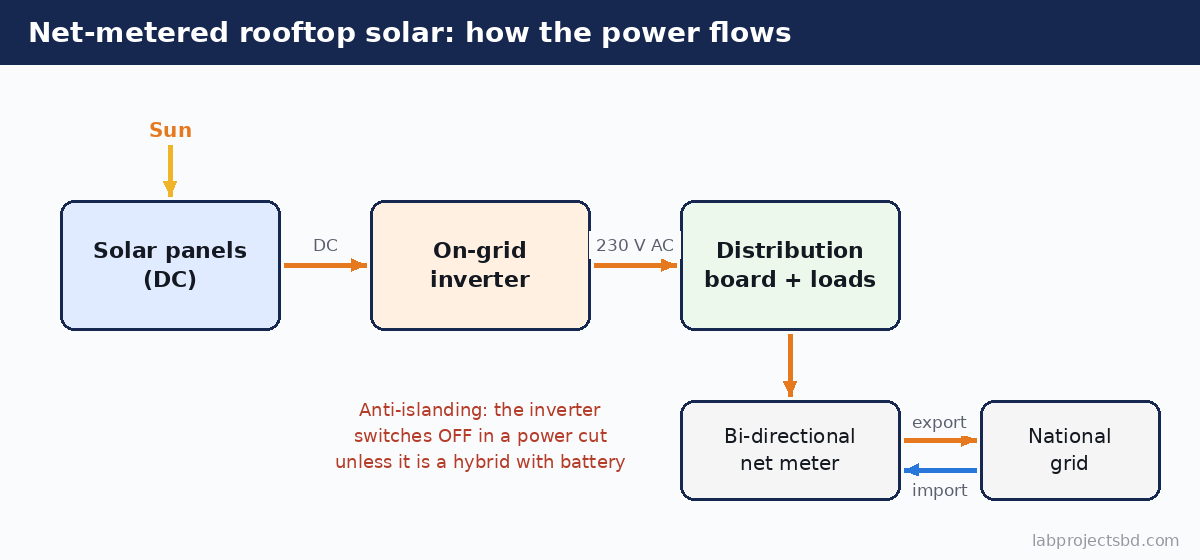
| On-grid (net-metered) | No | No. The inverter must switch off when the grid fails (anti-islanding) | Lowest cost per unit, cutting bills, earning export tariff |
| Hybrid | Yes (LiFePO4 recommended) | Yes, for the loads on the backup circuit | Homes that want bill savings and backup instead of an IPS |
| Off-grid (solar home system) | Yes, sized for all loads | Always (no grid) | Remote areas without reliable grid |
Many people expect solar to keep the fans running during a power cut, and then find that their on-grid system goes off with the grid. This is a safety requirement: it protects line workers repairing the grid. If backup matters to you, choose a hybrid inverter. Or keep your existing IPS. See our guide on choosing the right IPS for your home.
Size your rooftop solar system in 6 steps
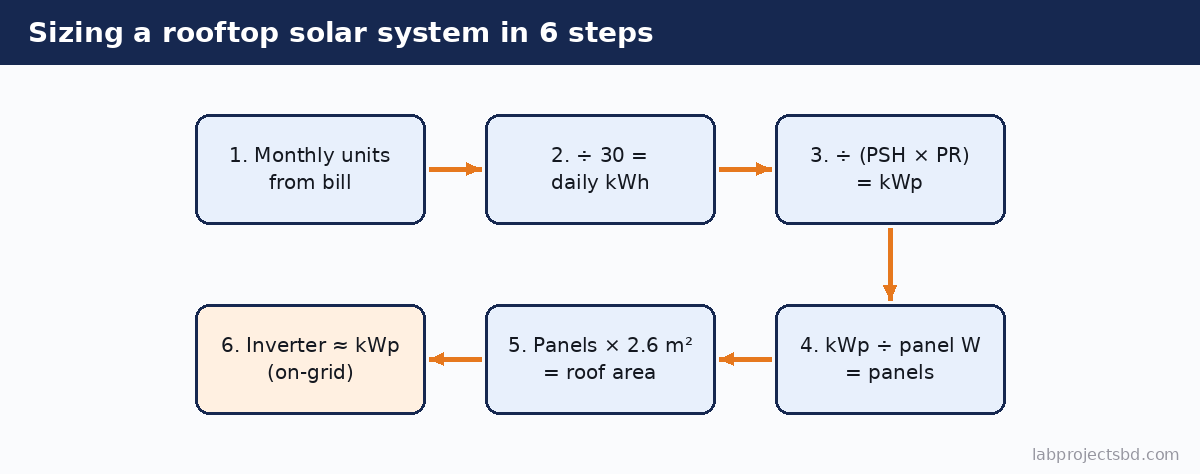
- Find your monthly units. Take the average kWh (units) from the last 12 bills. Summer months are higher because of fans and ACs.
- Daily energy = monthly units ÷ 30.
- Array size (kWp) = daily kWh ÷ (peak sun hours × performance ratio). For planning in Bangladesh, use about 4.5 peak sun hours/day as a yearly average and a performance ratio (PR) of 0.75. PR covers heat, dust, cable and inverter losses.
- Number of panels = kWp × 1000 ÷ panel watts (550–600 W panels are common now). Round up.
- Roof area ≈ panels × 2.6 m², plus 30–50 % for walkways, row spacing and the water tank shadow.
- Inverter: for on-grid, an inverter rating close to the array kWp (DC/AC ratio 1.0–1.2) is typical.
You can do the same calculation in seconds with our solar system size calculator.
Worked example: a 300-unit home in Dhaka
| Step | Calculation | Result |
|---|---|---|
| Monthly use | Average of 12 bills | 300 kWh |
| Daily use | 300 ÷ 30 | 10 kWh/day |
| Array size | 10 ÷ (4.5 × 0.75) | 2.96 kWp → choose 3.3 kWp |
| Panels | 3300 ÷ 550 W | 6 panels |
| Roof area | 6 × 2.6 m² × 1.4 | ≈ 22 m² (≈ 235 sq ft) |
| Inverter | On-grid, single-phase | 3 kW |
| Yearly generation (estimate) | 3.3 × 4.5 × 0.75 × 365 | ≈ 4,065 kWh |
How much money that saves depends on your tariff slab: every unit you use yourself is a unit you do not buy at your slab rate. Exported units earn the incentive tariff. For example, if 30 % of the 4,065 kWh is exported, that is about 1,220 kWh × Tk 10.50 ≈ Tk 12,800 per year on top of the bill saving. Plug your own slab rates into our electricity unit cost calculator to estimate payback. These are planning numbers. Real output depends on shading, tilt, dust and panel quality, so ask installers for a simulation with your exact roof.
Adding battery backup (hybrid systems)
Size the battery for the loads you need during load-shedding, not for the whole house:
- List the essential loads: fans, lights, router, maybe a fridge. Example: 500 W.
- Multiply by the backup hours you need: 500 W × 4 h = 2,000 Wh.
- Divide by the usable depth of discharge: LiFePO4 ≈ 0.9, lead-acid ≈ 0.5. LiFePO4: 2,000 ÷ 0.9 ≈ 2.2 kWh → a 48 V 50 Ah (2.56 kWh) pack fits well.
- Read our guide to choosing a LiFePO4 battery for IPS and backup for BMS and wiring details.
- Check that the hybrid inverter supports your battery chemistry and voltage, and has a BMS communication port (CAN/RS485) if you use a smart lithium pack.
Lead-acid batteries in hot rooftop rooms die quickly. Our guide on why IPS batteries die fast explains the reasons. Use our battery backup time calculator to try other loads.
Installation checklist (what to check in an installer’s quote)
- Structure: galvanised or aluminium frame, anchored to the roof slab, designed for strong wind. This matters even more in coastal and cyclone-prone districts.
- Shading: no shadow from water tanks, stair rooms or neighbouring buildings between about 9 am and 3 pm. Partial shade on one panel can pull down a whole string.
- Tilt and direction: panels facing south at roughly 20–25° tilt work well for most of Bangladesh.
- DC protection: DC isolator, correctly rated fuses, solar-grade DC cable, and MC4 connectors from the same brand on both sides.
- Earthing and surge protection: proper earth pits, an SPD on the DC and AC sides, and lightning protection if the roof is exposed.
- Cable sizing: keep DC voltage drop under about 2 %. Check it with our wire size and voltage drop calculator.
- Paperwork: net-metering application through your distribution utility, a bi-directional meter, and the inverter’s grid-compliance certificate.
- Warranty: panel product and performance warranties, inverter warranty, and a written service promise from the installer.
Curious how the electronics inside a solar charger work? Read our MPPT controller build guide.
Common mistakes when buying rooftop solar
- Sizing from one summer bill. Use a 12-month average; otherwise you oversize for winter and export more than you planned.
- Buying on price per watt only. A cheap inverter without proper grid-compliance certification may not be approved for net metering, and inverter failure is the most common fault in small systems.
- Ignoring roof waterproofing. Drilling the slab for anchors without sealing causes leaks in the monsoon. Ask how the structure is fixed and sealed.
- No monitoring. Without a Wi-Fi monitor or at least a daily meter reading, a tripped string or a failed inverter can go unnoticed for months.
- No cleaning plan. Dust, bird droppings and construction dust around Dhaka can cut output noticeably. Plan a safe way to rinse the panels regularly.
- Expecting backup from an on-grid system. As explained above, it will switch off during load-shedding by design.
Ask every installer for the same three documents: a written system design (panel layout, string sizes, inverter model), a yield estimate for your roof, and the warranty terms. Comparing quotes is much easier when they answer the same questions.
Frequently asked questions
Will an on-grid solar system run my home during load-shedding?
No. A grid-tie inverter must shut down when the grid fails. You need a hybrid inverter with batteries, or a separate IPS, for backup.
How many units does a 1 kW rooftop system produce in Bangladesh?
As a planning figure, about 1 × 4.5 × 0.75 × 365 ≈ 1,230 kWh per year, or roughly 100 units a month. It is lower in the monsoon and higher in the dry season.
Do I need a three-phase connection for net metering?
No. Under the Net Metering Guidelines 2025, single-phase users can also join. Your system size is still limited by your sanctioned load, so check with your distribution utility.
Which is better for solar backup: LiFePO4 or lead-acid?
LiFePO4 costs more at first but lasts many more cycles, gives more usable energy and handles heat better. For daily solar cycling it is usually cheaper over the battery’s life.
Is the Tk 10.50/unit tariff paid for all units my panels produce?
No, only for the surplus you export after your own use, and only for eligible systems installed by 28 February 2027, for three years.
Conclusion
Sizing rooftop solar in Bangladesh comes down to a few honest numbers: your average monthly units, about 4.5 peak sun hours, a 0.75 performance ratio and the space on your roof. Decide first whether you need backup (hybrid) or only bill savings (on-grid), then use the worked example to check any quote. With the export incentive open only for systems installed by February 2027, now is a good time to plan.
Need a solar monitoring device, MPPT controller or custom battery system? We design custom PCBs, firmware and complete working prototypes for students and companies. Message us on WhatsApp or use the contact form. You can write in Bangla or English.




0 Comments